


 0
0

Artist and author T. J. Bacon meditates upon the current climate for trans+ rights in Great Britain and encourages us to dream beyond this moment, enacting intersectional trans+ futures rooted in care.

In this text artist and author T. J. Bacon takes trans+ experiences and methodologies as a starting point to promote collective practices of care that can support us in engaging with one another across difference. She invites us to dream and build new worlds and intersectional futures, guiding us on a transition from this regressive moment towards a place of progression.
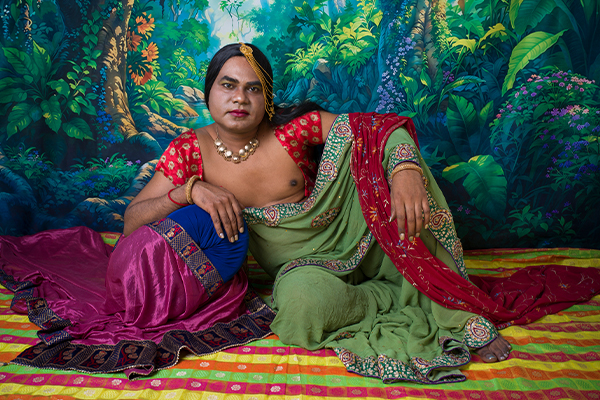
Responding to Autograph’s autumn exhibition season, Bacon explores the notions of intersectionality and multiplicity that are central to both exhibitions. While Our Bodies Have Been Bridges brings together the work of three feminist artists to highlight the possibility of connection across difference, Charan Singh’s solo exhibition – Your Tongue in My Mouth – celebrates the lives and collective resistance of India’s gender fluid communities.
Both exhibitions are free to visit at Autograph’s gallery in London until 13 February 2027.
Turning toward hope and practices of collective care, I write beside the artworks on display at Autograph. What I offer, and what I believe the exhibiting artists also offer, is an invitation to activate a daily practice of care alongside a refusal to become a tourist in lives that are not your own.
As you encounter the artworks, your own lived experiences will overlap, in both the micro and the macro. I encourage you to invite conversation with yourself and those around you. Listen with an activated sense of receiving memories or insights as the most precious gift. Be mindful when speaking, especially where your instinct is to be the first voice heard. But if you normally find yourself the last to speak, I equally encourage you to feel recognised today.
These meditations encourage numerous marginalised and intersectional experiences to sit together. My words are but one voice; I place this carefully before you and welcome yours to sit in meditation beside it and others, asking with a collective intention, what might we surface together each day?
To begin, can you recall a moment from your childhood when a disinterested relative or elder in your life may have asked you “what do you want to be when you grow up?” Perhaps in truth it was said with heartfelt honesty but whether it was a throwaway question or not, did they take the time to really listen to the answer? Either way I suggest we pose that question to ourselves again, as frequently as we want, no matter our age, allowing for a different answer each time. But rather than using this question as means to make conversation, we must draw a renewed sense of care to our answers. This is an offer to listen to ourselves deeply and actively: to allow a myriad of responses to grow like seeds awaiting the nurturing care of your time.

Koyoltzintli, Obsidian Woman, from the series Meda, 2019
Growth is rarely linear and certainly not always upwards, and there is opportunity to re/become who, or what we want to be, at any point in our journeys through life. Our Bodies Have Been Bridges demonstrates something similar in mapping three decades of artistry from Laura Aguilar, Tarrah Krajnak and Koyoltzintli in reclaiming a similar sense of re/becoming; a presence across time that can resist fixed ideas of who can be seen, and how. So, rather than allowing the question of growth to be relegated to our formative years; let us reinvent it today to ask, how do you perceive your being here, in this moment? Not the self, singular, but the self/s through which you manifest day to day — the multiplicity each of us already carries across worlds of work, family, play, politics, intimacy and life in general.
Our positionality and perspectives are in constant flux, I often try to capture this sense of oscillation through my use of a forward slash “/” in my writing, to invite an interpretation that is not binary but myriad in its possibilities. This can manifest through any number of ways such as the changes we want to bring about; the experiences perceived by us, through us, and upon us; or the certainty or uncertainty of the worlds we pass through.
For trans+ folk, especially those whose lives sit across multiply marginalised identities, the stability of certainty is often fleeting in the context of their human rights and freedom to live authentically. Place, time, wellbeing, healthcare, sex, security and employment all become actively disrupted by right-leaning political rhetoric, policies, institutions, laws and governments. At any time in our lives these may become compounded in either the bureaucracy of oppressive regimes or the targeted vilification of hate groups.
For example, recent legislative changes in Great Britian followed the Supreme Court's ruling in For Women Scotland (April 2025), leading to a revised EHRC Code of Practice (August 2026) that directly impacts the dignity, liberty and freedom of trans+ people. The resulting complexities within the policy have created the conditions for some service providers to feel emboldened to produce systems of segregation for trans+ access to facilities such as washrooms, changing rooms, wards, gyms, shelters and support groups. This is symptomatic of how legislation can trickle down into everyday acts of violence and harm. Something, the Everyday Disasters and Violence Research Group describes as “[s]mall disasters that can have a higher cumulative effect than those hitting the headlines.” Like a hidden leak destroying a building’s foundations, these changes impact how trans+ folk navigate their lives through each world they experience and over time accumulate to have immense consequences on basic everyday liberties.
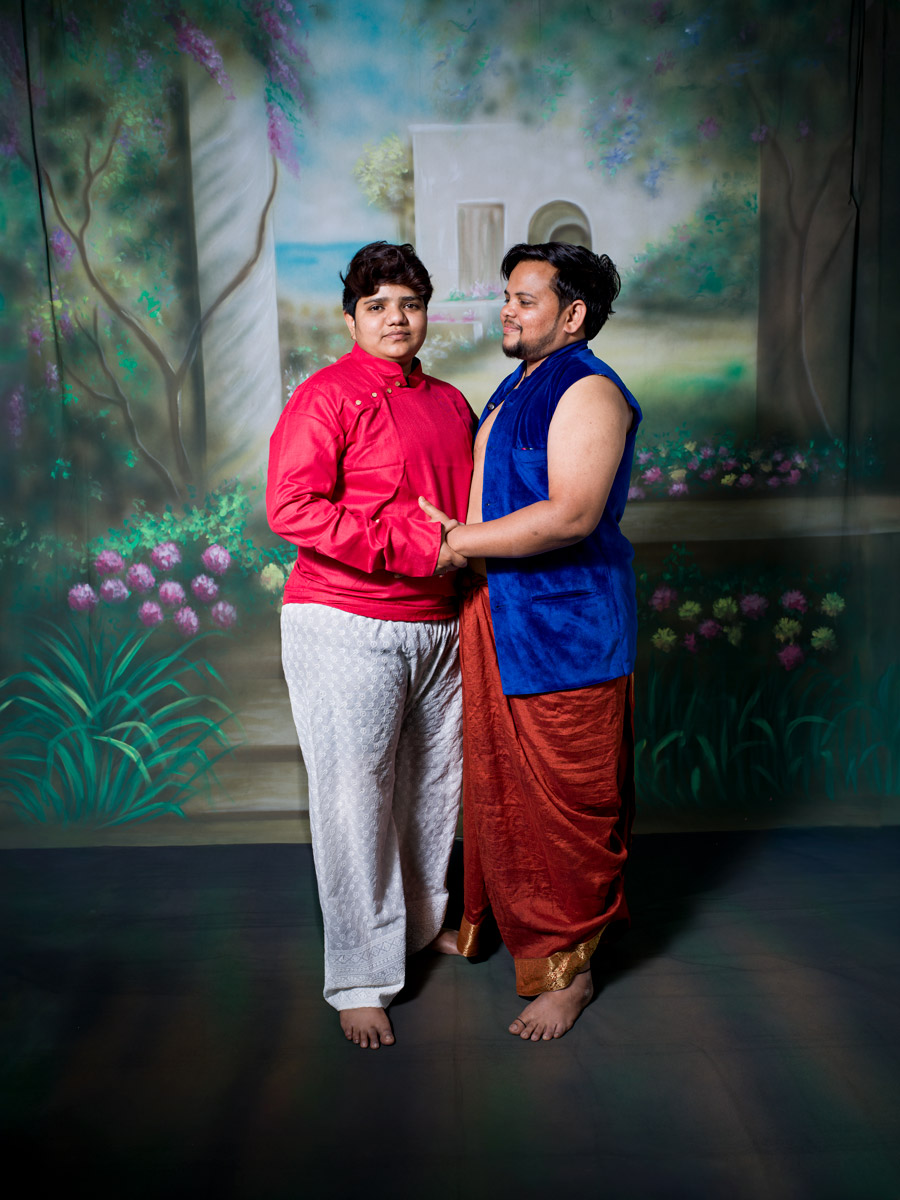
Charan Singh, Gopal & Shankar, 2026
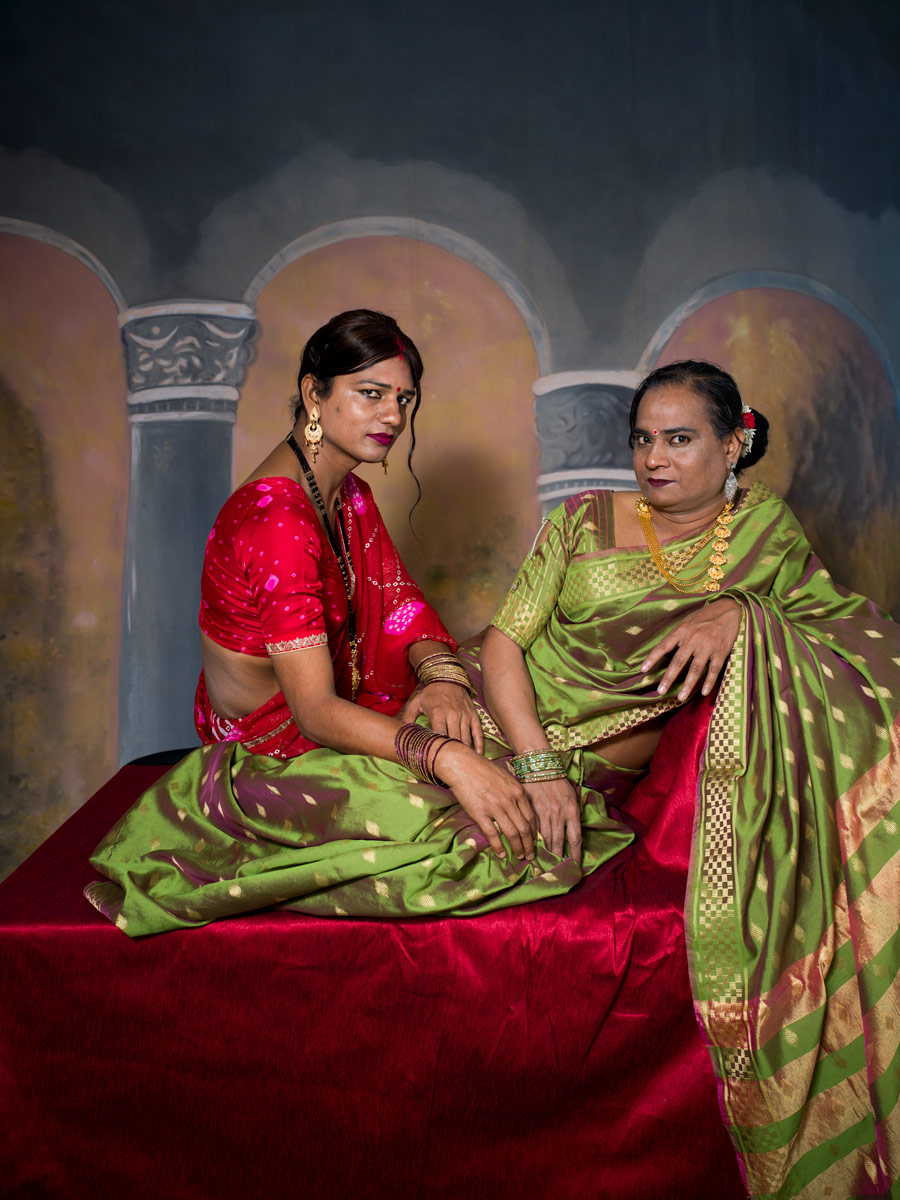
Charan Singh, Naagrani & Roopa, 2026
When left unchecked, such violences have the potential to silently grow, as comparably witnessed during the 15-year period of the Local Government Act of 1988, titled Section 28.¹ During this time, the so-called promotion of homosexuality in schools was legally banned, removing queer lives from the curriculum and stripping pastoral care that could engage with a queer perspective. The damaging legacy of this period is unquestionable and history has demonstrated how policy and law can lead to cumulative forms of structural violences. For trans+ people today there remains potential for this to manifest across increasing chronic healthcare denial, legislative erosion, and socio-cultural marginalisation.
Yet trans+ people have always existed throughout time, we are not going away and even in the bleakest moments, hope remains possible and care grows through allies, community, collectives and within ourselves. The diversity of identity in Charan Singh’s portraits of Hijra, Kothi and trans+ people in Your Tongue in My Mouth is an active celebration of such agency, beauty and queer hope in the face of politicised acts of repression that continue to be encountered in India.
This repression is not only a legacy of colonialism, but also a reflection of a current regime turning towards authoritarian tendencies, as explicitly witnessed in March 2026 when Prime Minister Modi’s government passed the Transgender Persons (Protection of Rights) Amendment Act. This amendment removed the statutory right to self-perceived gender identity and replaced it with more bureaucratic and medicalised processes, requiring greater state involvement in gender recognition. Yet when standing before Singh’s portraits, one is immediately transported to the wonder and beauty of each individual; a bold and vivid celebration of gender through not only a rich mise en scène but the captivating gaze of each subject; each complex and uplifting in form, emotion, being and time.
The etymology of trans – from the Latin meaning "across," "beyond," or "on the other side of" – offers a useful way of thinking about how transness functions as a modifier. In terms like trans-art or trans-disciplinary, it signals movement across established boundaries, a form of extension that connects disparate fields or identities. Within the context of a transgender experience, this transness exceeds simple notions of transition from one fixed point to another; instead, it suggests flux, relationality, and an ongoing becoming.
Trans in this sense is not merely a crossing but a re/becoming. Moving beyond the limitation of subjective thresholds such as patriarchy, heteronormativity or xenophobic nationalism, to trans is to offer all communities increased freedom to exist.
Nationalistic, authoritarian and regressive political regimes often seek to enforce borders and their unilateral control. Yet borders are representative of more than just the geographical division between countries. Increasingly borders are defining the limits of our very being, imposing governance upon the ontological or societal. Here borders are defined arbitrarily by binary thinking of what a ruling doctrine considers right or wrong. A morality that can be corrupted by patriarchal and misogynistic language to impact the bodily autonomy of not only trans+ lives but also cis.² The impact then becoming exasperated for any intersectional community navigating such restriction. For example, when transmasculine folk seek healthcare around menstruation they can often encounter stigma, but when those from the global majority, the elderly or disabled seek advocacy and support, each can become a multiplier towards a bias that restricts access.
To trans therefore opens an understanding of other voices, of perspectives and lived experiences, and plants the potential for world re/building
Hope however emerges through the imperative to trans which is at the heart of any trans+ lived experience; it is a demonstratable challenge to controlling borders. Trans in this context becomes a continual unfolding beyond such limits or restrictions. Here the potential for world building emerges, which can be shared across time, histories, oral traditions and cycles of renewal. Change has always existed in our lands and cultures but we have allowed it to be erased by those same border obsessed hegemonic voices of doctrine, dogma, policy, guidance, rule and law.
When writing on this in The Fluidity or Transmutability of Borders Held in the Lived Body of Trans and Non-Binary Bodies, I describe the potential impact of denying an individual’s agency for living authentically. Describing how this can result in the lived experience of that being becoming void and - when framed through an intersectional lens of race, culture, disability, age, and religion - that oppression becomes magnified. Yet equally within that magnification is an opposing and hopeful force; the potential for re/becoming anew through a celebration of diversity and difference.
Sara Ahmed’s approach to developing a Queer Phenomenology helped to frame this potential via a queer lens that opens how we may perceive the worlds around us, revealing the construction of each oppressive force. To consider any regime, law or doctrine in this way allows us to oppose it, change it, queer and disorientate the structural impact it was designed to oppress. For my own development of a Trans Phenomenology, to trans occupies a positionality and imperative for productive change. In this context it shifts perception beyond the limits imposed by binary thinking to consider what comes next? To trans therefore opens an understanding of other voices, of perspectives and lived experiences, and plants the potential for world re/building, not just of a singular bodily change but as a change that is existential, cultural, decolonial, historical, somatic, pagan, aesthetic, indigenous and more.
%20charan%20singh%2C%20rasili%2C%202026.%20commissioned%20by%20autograph%2C%20london.jpg)
Charan Singh, Rasili, 2026
Where trans gestures beyond, queer unsettles. It disrupts the assumed stability of categories and meanings, exposing their contingency and performativity. Queerness disorients perception, opening-up space for ambiguity, multiplicity, and the refusal of normativity. But to trans is also to queer, therefore it is not in opposition but rather offers an extension of form. Queer shifts perception and challenges normativity in much the same way that to trans does, but a trans+ perception also offers a hopeful path towards re/becoming that does not dwell in the uncertainty. Both are essential parts of one another: trans enacts a reconfiguration of relational possibility, while queer ensures that no new configuration becomes static or closed.
Much like the artwork on display, emerging across time and the histories both personal and shared, to trans is to continually rediscover through encounters of care and hope. To trans is to build new worlds.
The following scores are offered to explore a trans phenomenology of perception. Each invites you to create the conditions to trans your perception of worlds around you. They are designed to foreground kindness and practices of care.
When attempting the scores, you are invited to attune your embodied experience across four areas:
Orientate: What changes when you move from noticing your own actions and events to attending to the perception and feeling of witnessing other’s stories and journeys.
Project: Where do you become aware of projecting meaning onto others?
Sense: Does your own body react or sense in subtle ways that you would not normally observe?
Complicate: Does your own sense of bodily integrity – of your body as yours – surface at any point through its absence when considering the journey of others?
On Trans-ing Time:
Suspend the belief that the past lies behind you and the future ahead.
Listen quietly to others in a space.
Let yourself notice moments.
Attend to what has just-gone.
What is still sounding in the body?
What is not yet here yet?
On Trans-ing Gender:
Explore this score by reading it in every direction. Interpret this as intervention in any given moment, treating each word as an action.
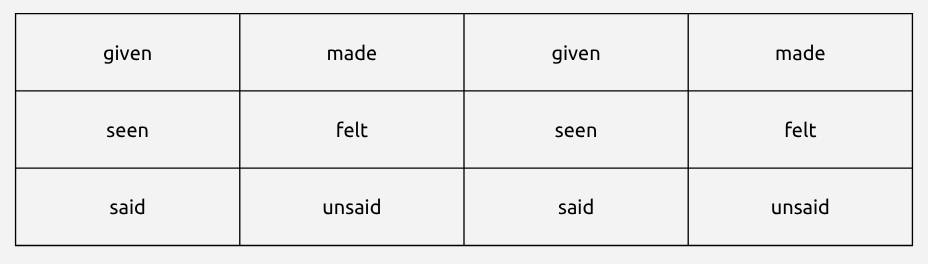
Whichever word you stop on becomes a decision on your lived experience of gender. Can you finish it?
On Trans-ing Borders:
Notice another body: the trace of one hand on a table; the cushion of their seat on a chair.
Allow them to leave.
Place your weight where theirs has been. Notice the seat still warm, the detritus left, the coldness or absence of a handprint.
Breathe until the breath is a shared inheritance.
Allow the moment to be something someone taught to you without meaning to.
Pass it on.
On Trans-ing Worlds:
Setting aside time for conversation and craft, invite a group to reflect on their lives while altering a piece of old clothing. Everyone should bring at least one item.
The garments go to the middle of the table and are dealt out at random, ensure nobody holds their own.
Each person spends the time changing the garment they hold: shortening, patching, unpicking a seam, taking something from another garment on the table.
Nobody asks the owner what they would like. But the changes should be infused by the stories they hear being shared throughout your time together.
Try to focus the conversation on your lived experience of moving through different worlds in your life rather than talking about the item of clothing you have brought in.
When the time is up, gift with a sense of care, the garments back to their owners after a brief introduction on why the changes were made and which stories helped to manifest those alterations.
The owner is invited to wear the garment, changed by someone else's hands and the collective words for as long as they choose.
The thread ends and offcuts are left on the table, unswept.
_______
¹ T. J. Bacon, Section 28 to Institutional Transphobia: Tracing the Evolution of LGBTQ+ Marginalization, Legacies of Section 28 Conference, UCL Institute of Advanced Studies, 2025
² As witnessed in the U.S. Supreme Court in 2022 with the overturning of Roe v. Wade.
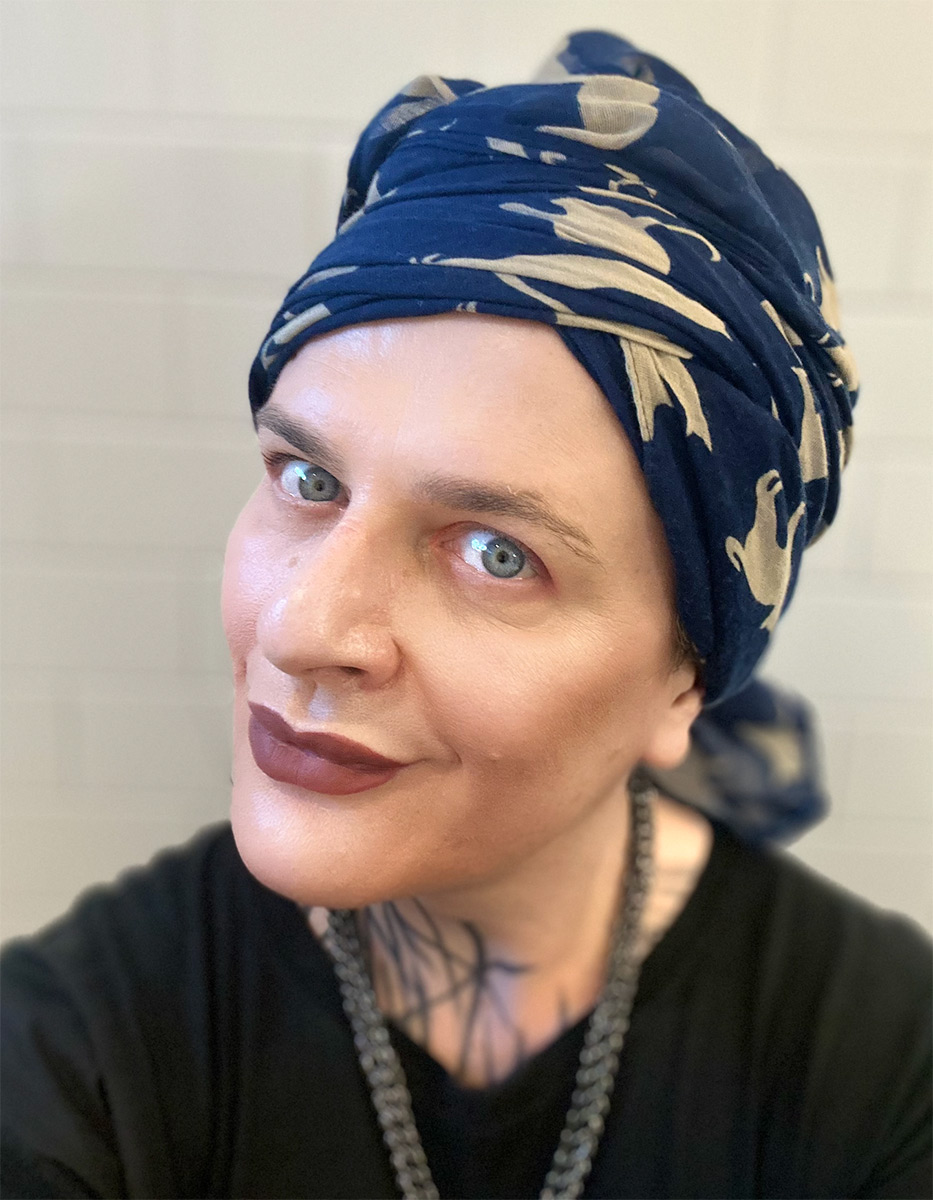
Dr Tōmei June Bacon (she/her) publishes as T. J. Bacon and creates artwork under the moniker tjb. She is a leading voice in the study of performance and visual art through queer phenomenological approaches.
From 2009 to 2017, her work established the phenomenology of a multiplicity of self/s, mapping the perception of multiplicity, embodiment, and temporality across experimental, interdisciplinary practices. This foundation was later developed through the application of queer phenomenology and continues to evolve through her groundbreaking developments towards a trans phenomenology.
She has published two major books in this area to date: An Introduction to the Phenomenology of Performance Art: SELF/s (Intellect/University of Chicago Press, 2022/24) and The Phenomenology of Blood in Performance Art (Routledge, 2025). Her third book, currently in development, expands her phenomenological inquiry into trans+ lives, art, and activism.
Her research operates at the intersection of transgender studies, phenomenology, queer theory, crip theory, disaster studies, and speculative futures, with applications in visual arts, experimental performance, and most recently the queering of XR technologies.
She is Professor of Interdisciplinary Practices at Guildhall School of Music and Drama and the founder of the Trans+ Virtual Centre of Excellence (TVCE).

Free exhibition
8 October 2026 - 13 February 2027
8 October 2026 - 13 February 2027
A free exhibition celebrating the lives and collective resistance of gender fluid communities in India
Banner image: Laura Aguilar, Motion #50 [detail], 1999. © Laura Aguilar. Courtesy of The Laura Aguilar Trust of 2016. Collection of Light Work, Syracuse.
Images on page: 1) Koyoltzintli, Obisdian Woman, 2019, from the series Meda. © and courtesy the artist. 2) Charan Singh, Gopal & Shankar, 2026. Commissioned by Autograph, London. 3) Charan Singh, Naagrani & Roopa, 2026. Commissioned by Autograph, London. 4) Charan Singh, Rasili, 2026. Commissioned by Autograph, London.
About the author: Courtesy T. J. Bacon.
Join our newsletter and get the latest on Autograph’s exhibitions, events, open calls, digital content, books, prints and fundraising. Find out more.



Autograph is a space to see things differently. Since 1988, we have championed photography that explores issues of race, identity, representation, human rights and social justice, sharing how photographs reflect lived experiences and shape our understanding of ourselves and others.
Support our work

