0
0
0
Free exhibition
Curated by Bindi Vora

Celebrating the lives and collective resistance of gender fluid communities in India

Autograph
Rivington Place
London EC2A 3BA, UK

Prebook free, timed tickets or visit anytime the gallery is open. Visiting with a group of more than 10 people? Book a free group visit here.

Wed, Fri: 11am - 6pm
Thu: 11am - 9pm
Sat: 12:30 - 6pm
Across South Asia, gender fluidity and sexual diversity have deep histories that have often been obscured and overlooked. Your Tongue in My Mouth examines how British colonial rule imposed rigid controls on gender expression and intimacy in India, criminalising long-established third gender, queer and trans communities.
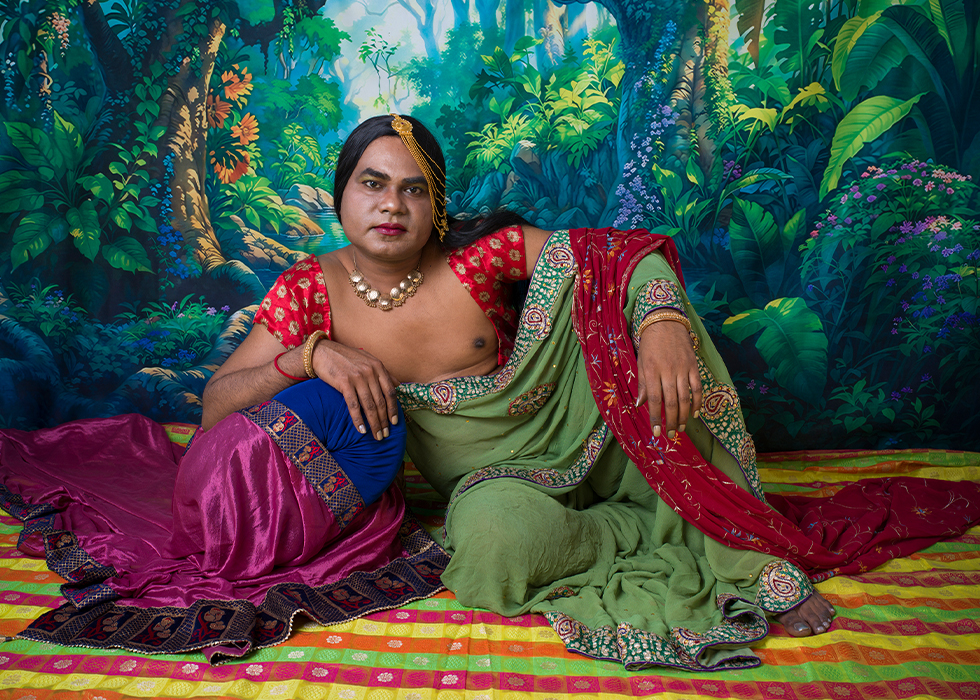
Charan Singh’s new portraits of Hijra, Kothi and trans people centre their agency as individuals and their shared histories; drawing on long-standing relationships Singh formed through more than two decades of HIV/AIDS advocacy and community organising. These new portraits affirm ways of belonging that existed long before colonialism, acknowleging the sitters’ right to define how they are seen, represented and understood.
The terms Hijra and Kothi refer to experiences of gender, identity and ways of life rooted in South Asian cultures that do not have direct English equivalents. For many Hijra, identity is connected not only to gender but also to shared traditions, cultural practices and social ties. Depending on the context, Kothi may speak to the ways gender, sexuality, desire and social relationships are expressed and understood.
Under British colonial rule, law became a tool for policing gender expression and intimacy. Section 377 of the Indian Penal Code (1861) criminalised sexual acts deemed to be ‘against the order of nature’, while the Criminal Tribes Act (1871) imposed restrictions on communities. These laws turned British colonial prejudice into public policy in India, with effects that continue to shape lives today.
Language sits at the centre of these histories. For many working class and economically marginalised queer people, barriers to education made vital information about HIV/AIDS harder to access and understand, particularly when much of it circulated in English with little available in the languages and dialects spoken. For communities already facing social and economic marginalisation, it also affected awareness of legal protections and human rights, further restricting access to healthcare and support.
At the heart of the exhibition a chronology traces how these histories have been written, contested and changed. Bringing together legislation, court judgments, community organising, political movements and acts of resistance from 1835 to the present, it rejects a simple story of progress. Instead, it shows how law has been used to define and control identities, while also being challenged through collective struggle. The chronology extends to the 2026 amendment to India’s Transgender Persons (Protection of Rights) Act (2019), which removed the right to self-identification and narrowed who could be legally recognised under the Act.
Singh’s portraits return us to the people living these histories – and to the collective resistance that continues to shape demands for rights and recognition.
%20charan%20singh%2C%20anita%2C%202026.%20commissioned%20by%20autograph%2C%20london.jpg)
Charan Singh, Anita, 2026
%20charan%20singh%2C%20umrao%2C%202026.%20commissioned%20by%20autograph%2C%20london.jpg)
Charan Singh, Umrao, 2026
%20charan%20singh%2C%20sonu%2C%202026.%20commissioned%20by%20autograph%2C%20london.jpg)
Charan Singh, Sonu, 2026
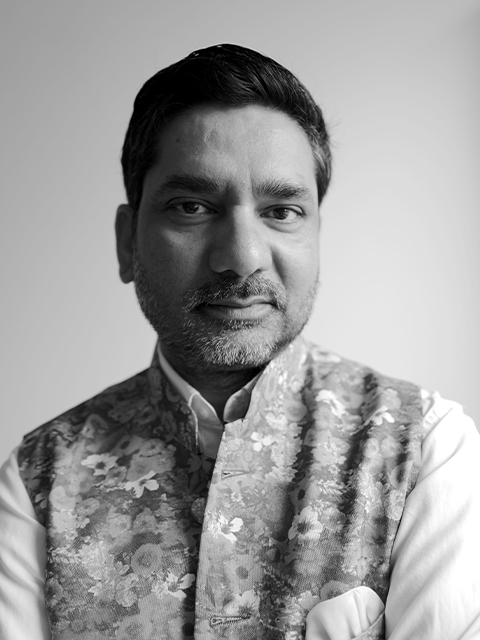
Charan Singh (born 1978, Delhi, India) is an interdisciplinary artist who explores the mediums of photography, video and text to understand how language shapes queer landscapes and the politics of representation.
Prior to coming to the UK in 2012, Singh was a non-English speaker and had an unusual relationship with the English language, where words got altered and they adopted new meanings. He often uses his 'pre-English language' gay life to question the legitimacy of certain forms of queer histories in India and the UK.
Previously an AIDS worker in India, he retrained as an artist, leading to a research interest in queer theory that comes from a place of the void of subaltern representations and the desire to agitate that void and foregrounds the significance of storytelling as a knowledge system.
Singh holds a master's in fine art from the University of Creative Arts, Farnham and a PhD from the Royal College of Art. His work has been exhibited at The Art House, Wakefield; The Photographers’ Gallery, FotoFest, Houston amongst others. His writing has appeared in Photo South Asia, TAP Review and On Curating. Singh has been commissioned by Visual Aids (New York), The Art House, Wakefield and Fierce, Birmingham. He lives and works between London and Delhi.

Introducing Autograph's new exhibition by Charan Singh
Read | 3 min read
Tracing the impact of British colonial rule on gender and sexuality in India
Read | 12 min read
Singh discusses the creative, colonial and historical contexts of his new portraits
Read | 12 min read
Songs from Indian cinema, carrying queer meanings for the people portrayed in the exhibition
ListenA text by Singh, challenging colonial frameworks for understanding queer identity and desire in India
Read | 12 min read We would like you to know before your visit that the chronology in this exhibition features archival sources, which at times contain outdated terminology.
With thanks to Beyond Print for their generous production support of Charan Singh: Your Tongue in My Mouth.
.png "sample")

Banner image: Charan Singh, Rasili, 2026. Commissioned by Autograph, London.
Exhibition preview, all images commissioned by Autograph, London: 1) Charan Singh, Anita, 2026. 2) Charan Singh, Umrao, 2026. 3) Charan Singh, Sonu, 2026.
About the artist: Courtesy the artist.
Open calls: 1) Photography by Kate Elliott. 2) Koyoltzintli, Obsidian woman [detail] from the series Meda, 2019. Courtesy the artist.
Join our newsletter and get the latest on Autograph’s exhibitions, events, open calls, digital content, books, prints and fundraising. Find out more.



Autograph is a space to see things differently. Since 1988, we have championed photography that explores issues of race, identity, representation, human rights and social justice, sharing how photographs reflect lived experiences and shape our understanding of ourselves and others.
Support our work