


 0
0

Artist Tarrah Krajnak discusses working with unstable archives and utilising this instability as a means of refusal and survival
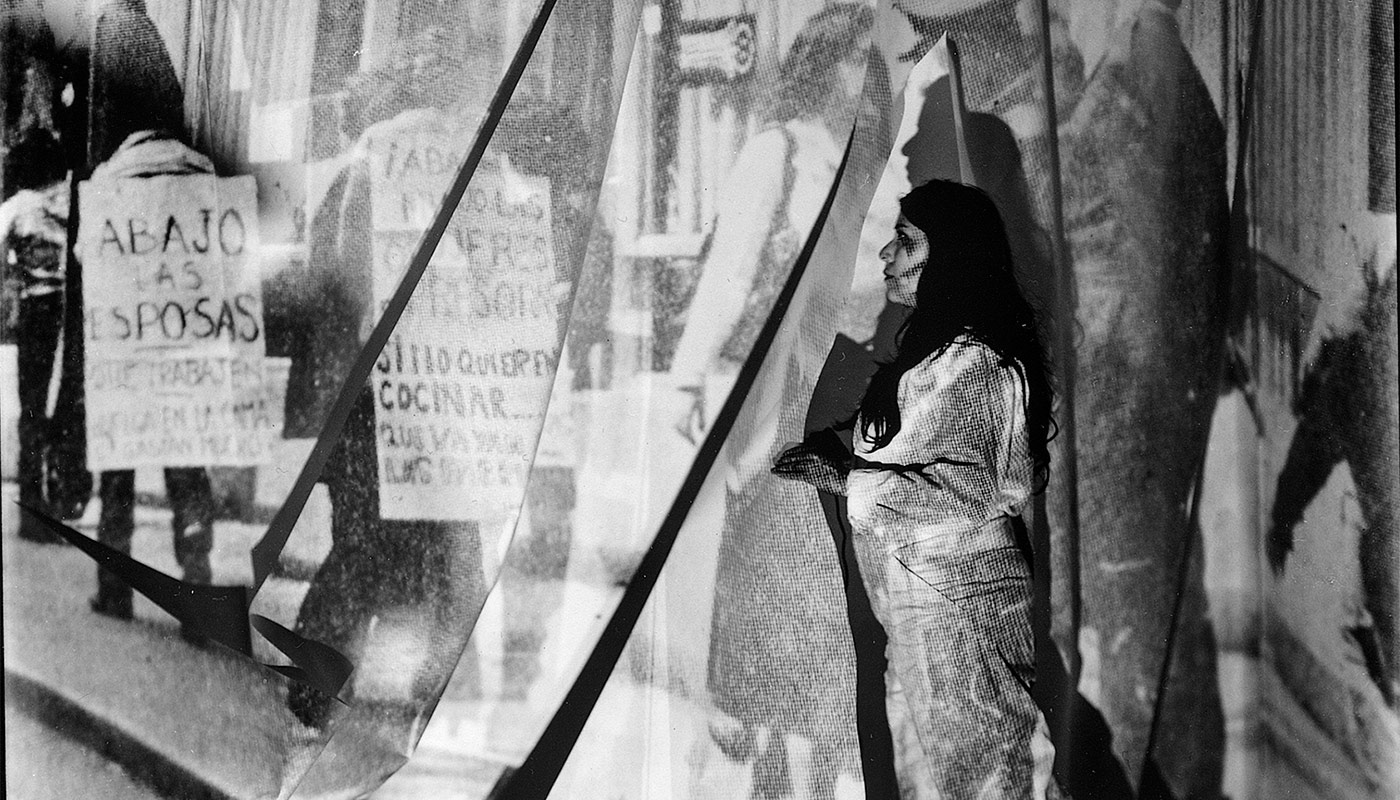
Tarrah Krajnak is an artist and educator born in Lima, Peru and based in Los Angeles. Her work features in Autograph’s new exhibition, Our Bodies Have Been Bridges, alongside work by Laura Aguilar and Koyoltzintli.
Here, the artist speaks with Autograph’s Senior Curator, Bindi Vora, about the two series of Krajnak’s works on display in the exhibition. They discuss the instability of photographic archives, the role of the body in reworking histories and what it means to return to a past that cannot fully be recovered.
Our Bodies Have Been Bridges is on display at Autograph and free to visit until 13 February 2027.
Bindi Vora (BV): Throughout your practice, questions of origins and belonging are often explored in relation to absence and loss. In the series El Jardín De Senderos Que Se Bifurcan (Senderos), how did the figure of the orphan become a way of thinking beyond familiar narratives of return, ancestry and ‘home’?
Tarrah Krajnak (TK): I was thinking about the figure of the orphan across poetry, literature and history. I was also interested in “orphaning” as a verb and its connection to national identity. I wanted to work against the familiar adoption narrative of “return” or longing for “home”. As an infant, I was adopted into a white, working-class American family and brought to the U.S. In the work, I ask what it means to live without a deep connection to a place or homeland or community.
Making work from a position of deracination and difference is not the same as making work about identity though. I think of words like identity and kinship as being associated with belonging and sameness, so the distinction opens up other readings in the work that are important to me and are more aligned with refusal, illegibility and the irreparable. In both Senderos and 1979 Contact Negatives I actively turn towards loss, absence, pain and negativity rather than towards healing, joy or tenderness.
In the work I was not interested in locating or documenting my community, or in the fantasy of recovering ancestral roots. Nothing is resolved in the work or through the work, and there is no past that can be recovered. Rather I am inspired by radical feminist writers like Hak Kyung Cha, Kathy Acker and Alexis Pauline Gumbs - in their work, negativity and illegibility serve as a means of refusal and survival. At the time, I was teaching and studying poets including Theresa Hak Kyung Cha, Layli Long Soldier and Robin Coste Lewis. My engagement with their work shaped the non-linear structure of Senderos as well as recurring elements such as the doubling or twinning, and the book within a book format.
%20tarrah%20krajnak%2C%2014%20self%20portrait%20with%20woman%20crossing%20picket%20line.jpg)
Self Portrait with Woman Crossing Picket Line, from the series 1979 Contact Negatives, 2019
%20Tarrah%20Krajnak%2C%2016%20Self%20Portrait%20with%20Woman%20at%20Hostal%20(Sitting).jpg)
Self Portrait with Woman at Hostal (Sitting) from the series 1979 Contact Negatives, 2019
BV: Another figure who emerges throughout Senderos is Sarita Colonia. How did she come to occupy such a significant place in the work?
TK: Across my work I grapple with emptiness, using both writing and photography to reflect on my relationship to origins, transracial adoption and orphanhood. The figure of Sarita Colonia has supported me in this practice, and she appears in many forms throughout the work – she is an unofficial catholic folk saint in Lima, considered “the saint of the people”. I discovered her when I was researching the institutional silence, racism and dismissal that indigenous women were met with when they tried to report sexual assault. Sarita Colonia is a cultural icon whose own story is shaped by this repressed trauma and institutional silencing. Her figure emerges in times of crisis and social upheaval because she represents the resilience of indigenous women, the working class, and migrant communities. She helped me to understand the role of storytelling, folklore, and magical realism within Peru’s patriarchal culture where crimes against indigenous women were not openly discussed, were repressed and went largely unrecorded.
BV: The question of how violence is documented, or goes unrecorded, also emerges in 1979 Contact Negatives. The year 1979 marks both your birth in Lima and a turning point in Peru's history, as the country emerged from military rule and approached decades of political violence and unrest. In this series you return to this period through photographs published in Peruvian magazines, where you discovered that the images did not always correspond to the people or events described in their captions. How did this discovery change your understanding of the archive and photography's role as evidence?
TK: At first, when I started creating the series, I wanted to go back to the actual locations of sexual violence depicted in the 1979 magazines I collected in Lima. My intention was to “re-photograph” the locations in the present day. Soon I discovered that this would be impossible because the locations were not necessarily real. These photographs do not operate in the expected way. For example, the same photo accompanying a story about sexual assault in one month’s issue might be used to illustrate an entirely different story, circumstance or crime in another month’s issue. In other words, the locations in the photos - even when an address is given - are not always the actual locations where the events took place. The people depicted are also not necessarily the people referred to in the stories or captions.
Photography’s roles as witness and evidence become tremendously complicated in the context of these magazines. Something that may look like a journalistic or news item sits somewhere between the real and the imagined – operating more like a stock photo, stand-in, proxy or substitute.
At this point I had been working with found photographs and archival documents for many years, so this discovery did not surprise me as much as it reinforced my understanding of the archive as always unstable, changing and malleable. In a way, these magazines and photographs – and the way they are depicting Peru’s history – mirror my own relationship to origins.
%20Tarrah%20Krajnak%2C%20Dead%20Ringer%20(Self-portrait%20as%20Found%20Photograph)%20from%20the%20series%20Senderos.jpg)
Dead Ringer (Self-portrait as Found Photograph), from the series El Jardín De Senderos Que Se Bifurcan, 2011-22
-Tarrah-Krajnak%2C-Holding-Hands-2-from-the-series-Senderos.jpg)
Holding Hands 2, from the series El Jardín De Senderos Que Se Bifurcan, 2011-22
BV: Your images bring together different places, bodies and moments in time, yet the processes through which you make them are often slow, repetitive and physically demanding. I'm interested in how the labour of collecting and working with these materials becomes part of the work itself. How does this sustained engagement shape your relationship to the archive and the histories it contains?
TK: A curator once asked me where I found these magazines as she assumed I bought them on eBay, but the act of collecting and assembling the materials with my own hands was part of the work for me. I started collecting the magazines nearly 15 years ago; I found them discarded in old dingy basements and at book stalls in Peru. It took years to cobble together this unofficial “archive” of 1979, rescuing it quite literally from debris. After a day of sifting and searching I would come back to my studio completely covered in the smell of musty basements, my hands sticky and black. The magazines themselves smelled mouldy and bugs had eaten tiny holes through the pages. My relationship to these materials therefore began with a bodily connection, before I even began working with them in the studio.
In Senderos I use rephotographic processes of layering, performance, and repetition to activate the archive through the body. I have worked with these magazines and photographs for many years and I continue to go back into them rearranging, reassessing, reimagining and remembering. Throughout my work, I am engaged in a dialogue with history. I am interested in the differences and similarities between processes such as remediation, reenactment, reinterpretation, reappropriation, homage, emulation, arrangement and reproduction. This ‘re-ness’ is a way of returning to existing images and histories without simply repeating them.
When I initially began travelling to Lima in 2011, I rented a cheap empty studio with no plans. I had a room, a 35mm camera, a bag of film, my body, and the city. I intentionally resisted literal self-portraiture. I would go out and collect materials during the day and bring them back into the studio to see what I could do with them. In a way, a lot of my work with archival material has this element of chance encounter. A conversation begins to emerge between the fieldwork – or the act of collecting materials around the city – and the studio work of building temporary juxtapositions between the materials and re-photographing them. At the time I was looking at artists such as Barbara Kasten and Leslie Hewitt, but I was also reading Miguel López and the writings of performance artist Giuseppe Campuzano.
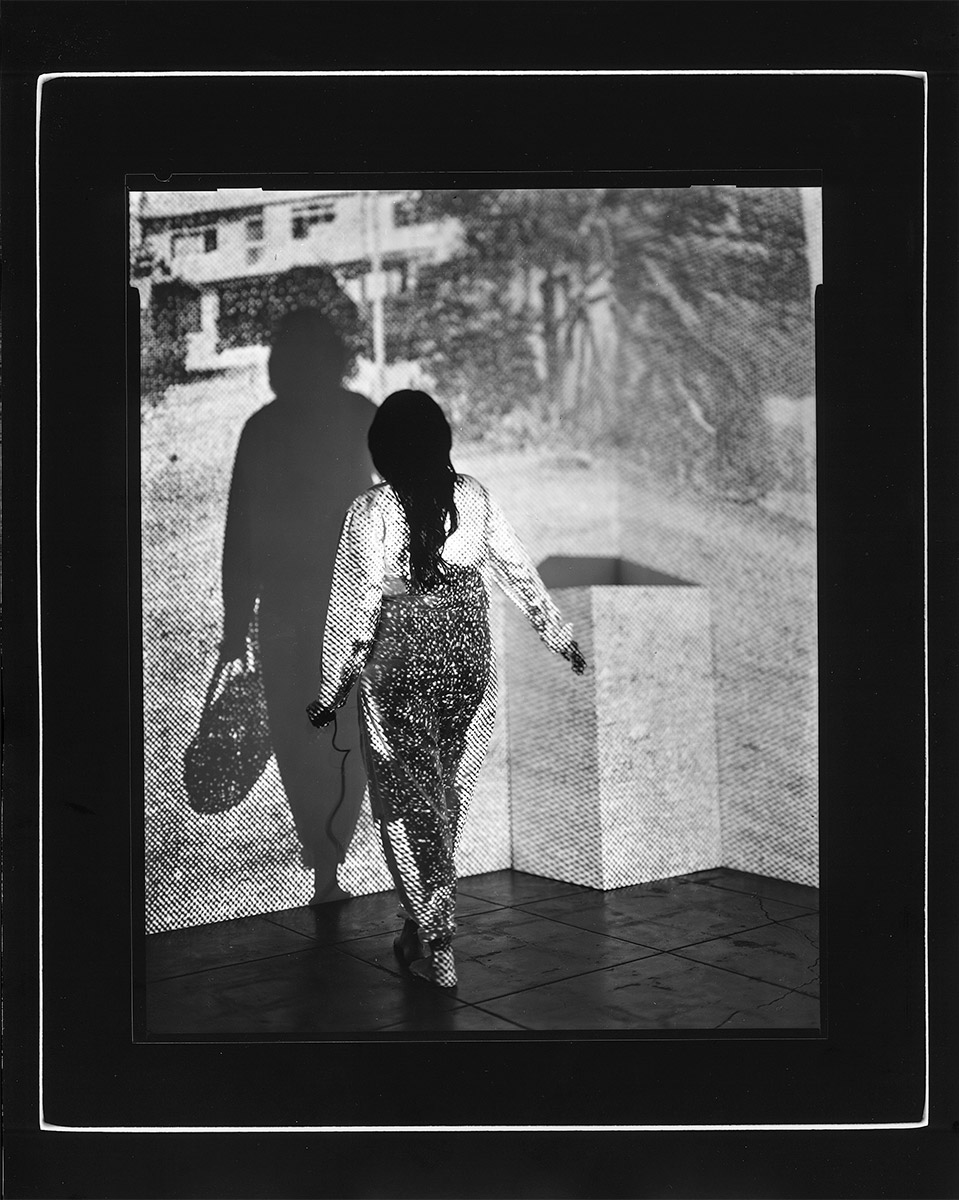
Self Portrait as Walking Woman with Bag, from the series 1979 Contact Negatives, 2019
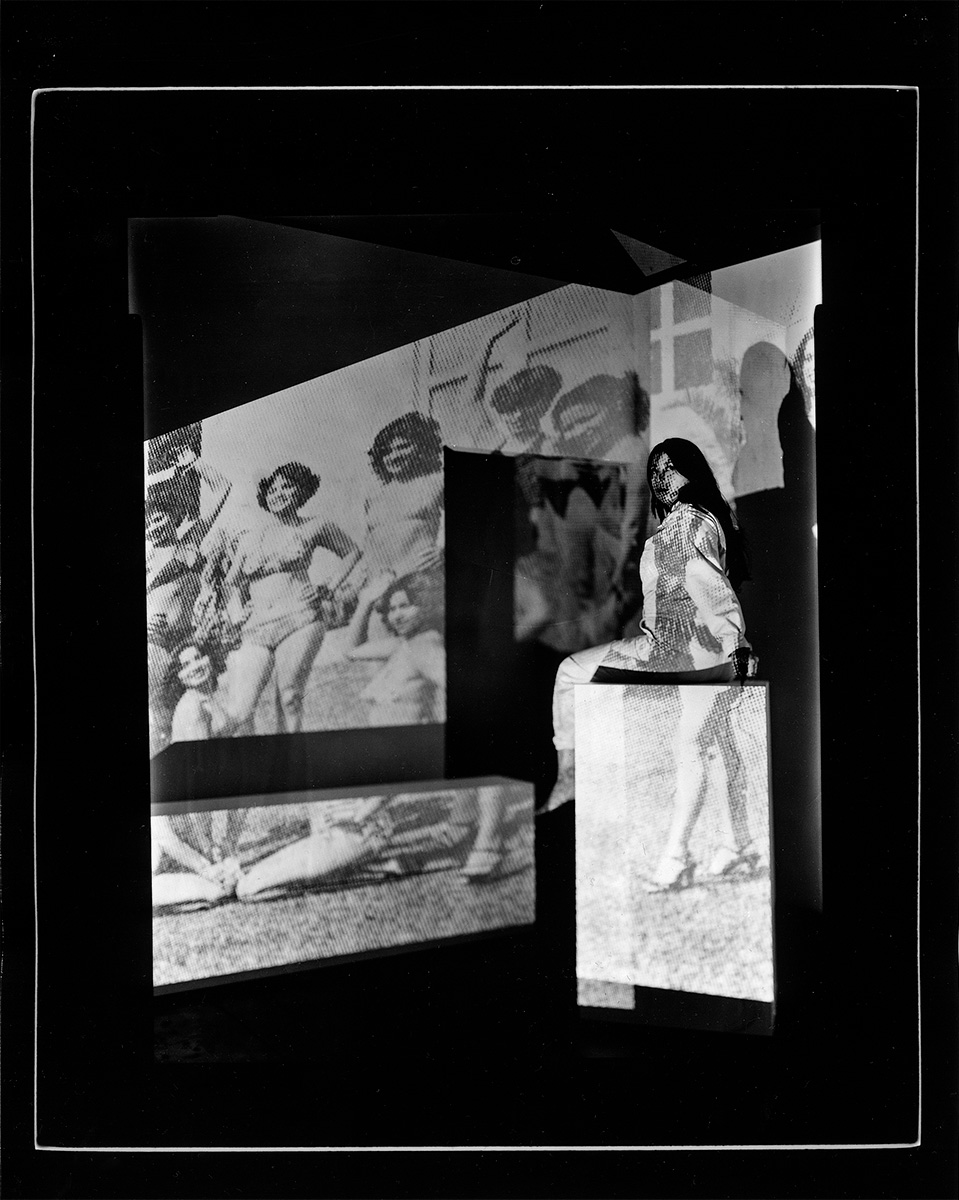
Self Portrait as Miss Universe Contestant (Sitting), from the series1979 Contact Negatives, 2019
BV: This physical relationship to the archive takes on another dimension in 1979 Contact Negatives, where your body becomes the surface onto which archival photographs are projected. The series began as a live performance before becoming the photographs we see in the exhibition. What does bringing your own body into these images make possible that working with the archival material alone might not?
TK: Yes, my body is the medium. When I am working with archival documents, I use my body to re-stage, re-produce, re-enact and resurrect the past. 1979 Contact Negatives began as a live performance and the photographs you see in the exhibition are documents of that performance. I projected images from 1979 Peruvian political magazines onto my body. I either stand in and directly trace the outline of the bodies projected onto me or hold them figuratively through the architecture of the stage I create. During these performances I use the gallery as a temporary darkroom and photo studio. Floor-to-ceiling sheets of white paper and rectangular blocks form the stage and backdrop. You can see my body in the photographs holding the cable release.
I had been working with the magazines for years and my book featuring the work, titled RePose, was ready to be published, but I still wanted a way to exhibit this work that was not static because so much of the difficulty of making the work was about movement, instability and unknowing. I wanted an audience to experience the process: the ghostly projections filling a darkened room, large wooden 8x10 cameras with dark cloths over them hovering around with my cable release attached to me like an umbilical cord.
BV: Returning to existing images and histories is central to your practice, but what happens when you return to your own work? You've spoken about how an artwork can take on different meanings over time. What does revisiting something you made years earlier reveal to you?
TK: Yes, I mean, I encounter this not just with my own art but also with art that I come back to again and again. It is almost like listening to a favourite song of mine from when I was 14 years old you know? The lyrics come flooding back and I am singing along without realizing it, and I can even remember the reason why it was so powerful to me at that time, but it is the awareness of both the past self and the present self-collapsed into one that makes this song resonate. I think returning to my “earlier” artwork is similar and necessitates an ongoing dialogue across time. What is revealed to me is that the art we make and thrust into the world has a life and its meaning evolves and is shaped over time in ways that are out of my control.

Free exhibition
8 October 2026 - 13 February 2027
Banner image: Tarrah Krajnak, Self Portrait with Woman Crossing Picket Line [detail]. From the series 1979 Contact Negatives, 2019. Courtesy of the artist and Zander Galerie, Cologne.
Images on page: 1) Tarrah Krajnak, Self Portrait with Woman Crossing Picket Line. From the series 1979 Contact Negatives, 2019. Courtesy of the artist and Zander Galerie, Cologne. 2) Tarrah Krajnak, Self Portrait with Woman at Hostal (Sitting). From the series 1979 Contact Negatives, 2019. Courtesy of the artist and Zander Galerie, Cologne. 3) Tarrah Krajnak, Dead Ringer (Self-portrait as Found Photograph). From the series El Jardín De Senderos Que Se Bifurcan, 2011-22. Courtesy the artist and Zander Galerie, Cologne/Paris. 4) Tarrah Krajnak, Holding Hands 2. From the series El Jardín De Senderos Que Se Bifurcan, 2011-22. Courtesy the artist and Zander Galerie, Cologne/Paris. 5) Tarrah Krajnak, Self Portrait as Walking Woman with Bag. From the series 1979 Contact Negatives, 2019. Courtesy of the artist and Zander Galerie, Cologne. 6) Tarrah Krajnak, Self Portrait as Miss Universe Contestant (Sitting). From the series 1979 Contact Negatives, 2019. Courtesy of the artist and Zander Galerie, Cologne.
Visit: Laura Aguilar, Motion #50 [detail], 1999. © Laura Aguilar. Courtesy of The Laura Aguilar Trust of 2016. Collection of Light Work, Syracuse.
Join our newsletter and get the latest on Autograph’s exhibitions, events, open calls, digital content, books, prints and fundraising. Find out more.



Autograph is a space to see things differently. Since 1988, we have championed photography that explores issues of race, identity, representation, human rights and social justice, sharing how photographs reflect lived experiences and shape our understanding of ourselves and others.
Support our work

