


 0
0
0
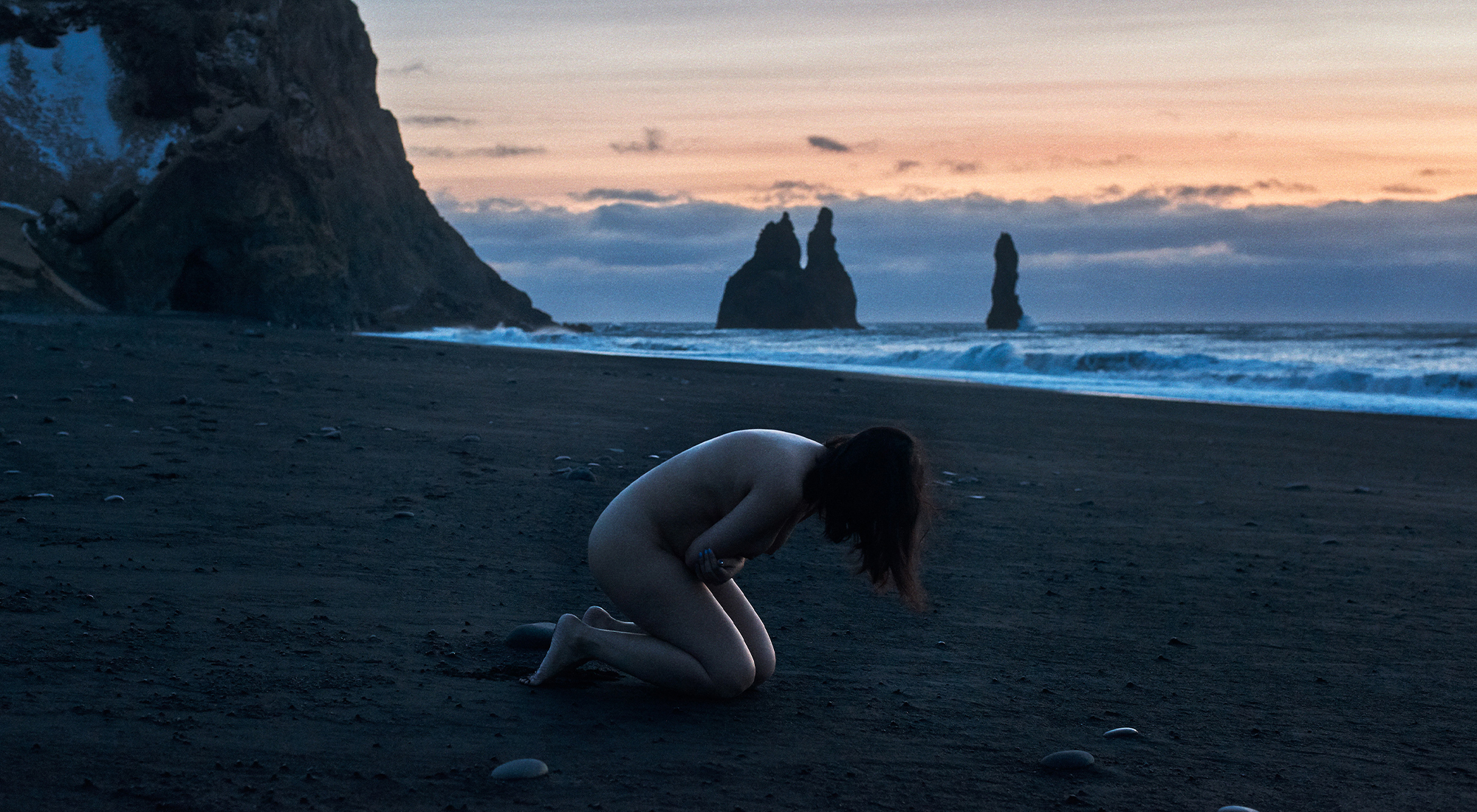

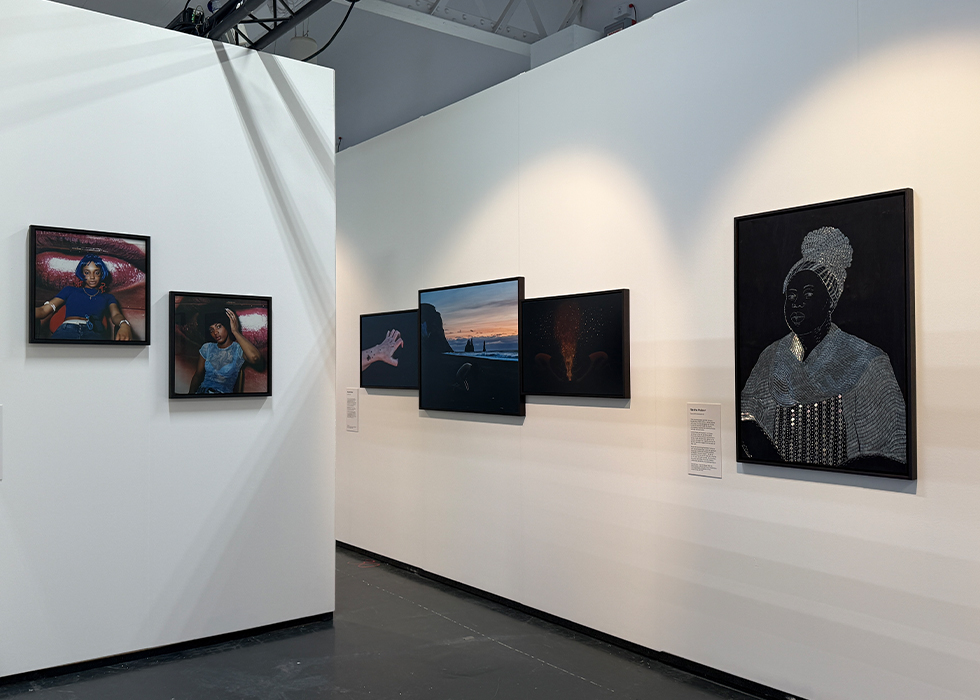
Autograph has one of the UK’s most significant holdings of photography addressing race, identity, representation, human rights and social justice. In a new exhibition at Photo London, we bring together a selection of work by women and non-binary artists from our collection of photography.
Spanning the late 1980s to the present, We Are the Ones We Have Been Waiting For traces a cross-generational lineage of artists who use the image as a space of resistance and imagination. From the incisive self-portraiture of Zanele Muholi to the pioneering conceptual practice of Carrie Mae Weems, the exhibition foregrounds artists who have used the photographic image to question who is seen, remembered and represented within the photographic archive. Most of the works on display were commissioned through Autograph’s ongoing commitment to support artists whose practices challenge dominant histories
Here we share some of the works on display and more from our collection.
%20eileen%20perrier%2C%20from%20the%20series%20afro%20hair%20and%20beauty%20show%2C%201998-2003.%20collection%20of%20autograph%2C%20london.jpg)
From the late 1990s to early 2000s, Eileen Perrier photographed attendees at the annual Afro Hair and Beauty Show at Alexandra Palace – a key event celebrating African and Caribbean hair culture.
For Perrier, the series is deeply personal: “Growing up, my hair was often styled in cornrows or wrapped in black cotton thread… over time I moved through braids, wigs, a shaved head and eventually locks”.
These images reflect the cultural and personal significance of hair and hairstyles as symbols of pride and resistance.
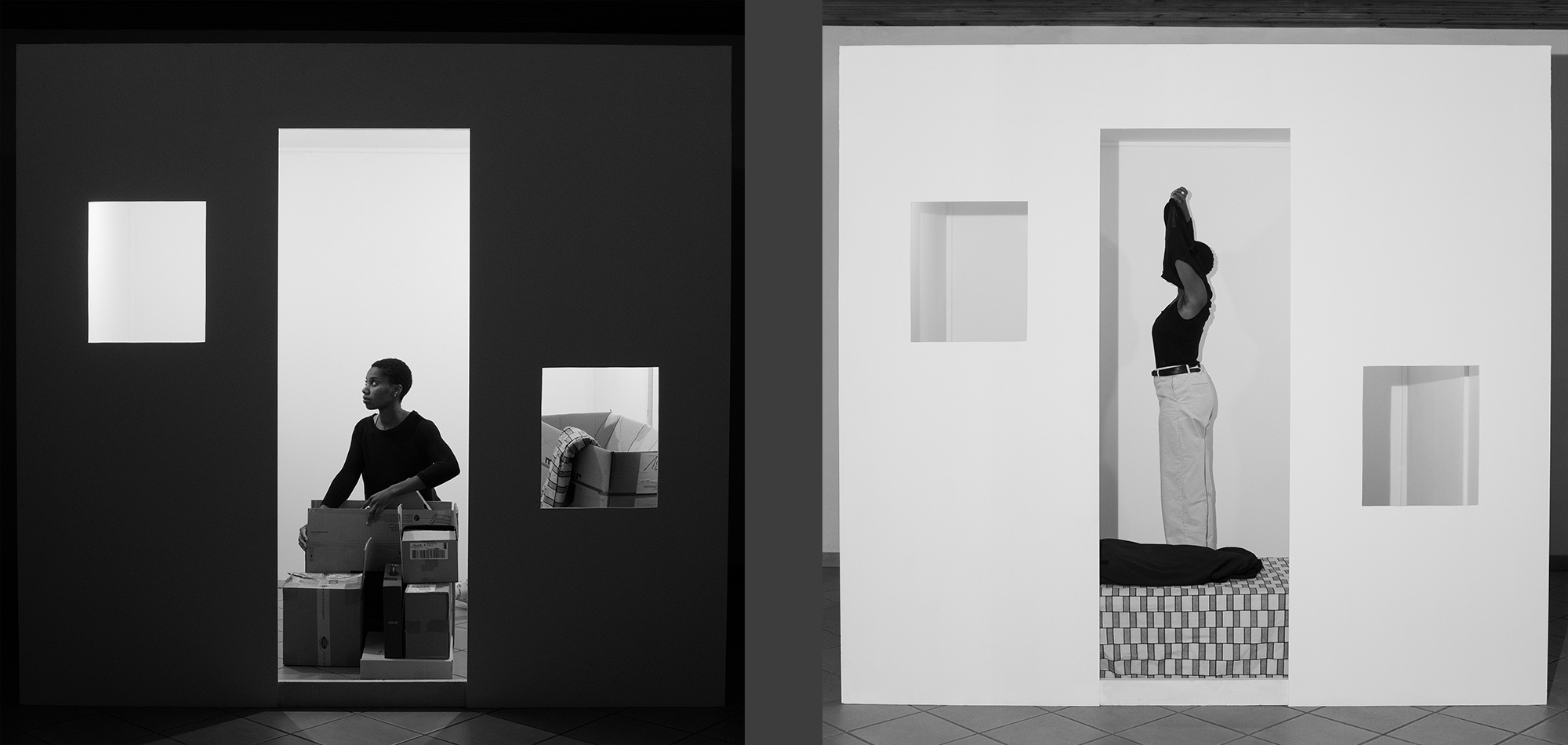
Neither Could Exist Alone was created in response to the Covid-19 pandemic. In this series, Silvia Rosi reflects on how the virus reshaped social behaviour and our experience of connection.
To make the work, she constructed a room in her family home in Italy based on the dimensions of her former London flat. Using photography and film, she stages and re-enters this space to explore isolation, the loss of touch and the structures we build around ourselves.
While rooted in personal experience, the work speaks to a shared condition of separation and uncertainty.
%20ingrid%20pollard%2C%20from%20the%20series%20the%20valentine%20days%2C%202017.%20commissioned%20by%20autograph%2C%20london.jpg)
Valentine Days is a series of hand-tinted large-scale prints Ingrid Pollard created from 19th-century postcards of Jamaica, originally produced by Valentine & Sons. These images presented a carefully constructed and romanticised vision of the island as a commercial and tourist paradise under British colonial rule.
Pollard’s practice engages with representation, history and identity. Through the process of hand-tinting, she reworks the image, drawing attention to the black figures within it and shifting the narrative of the original photograph.
The figures emerge as individuals with agency, foregrounding lives that were marginalised within colonial image-making and revealing the layered histories embedded in the image.
%20lina%20iris%20viktor%2C%20we%20are%20the%20night%20-%20the%20keepers%20of%20light.jpg)
We are the Night – The Keepers of Light centres on a solitary female figure, embodied by Lina Iris Viktor. Inhabiting an imagined monochrome landscape punctuated by solar and lunar symbols.
Drawing on influences from classical mythology, astronomy and African symbolism, Viktor works across mediums to create richly layered images. The figure’s commanding presence resists fixed interpretation, challenging historical representations of black bodies. The work reclaims blackness as a site of power and value, responding to colonial narratives and the myth of Africa as the ‘dark continent’.
%20zanele%20muholi%2C%20bayephi%20iii%2C%20constitution%20hill%2C%20johannesburg%2C%202017.%20commissioned%20by%20autograph%2C%20london.jpg)
In this self-portrait from Somnyama Ngonyama (isiZulu for Hail the Dark Lioness), Zanele Muholi uses their body as a site of resistance to confront the politics of race and representation within the visual archive.
Highlighting the 1956 Women’s March on Pretoria – a pivotal moment in South Africa’s history – the work honours collective acts of defiance against laws that restricted the movement and rights of black women.
Photographed at the Old Fort Prison complex in Johannesburg, where many protesters and political prisoners were detained under apartheid, the image connects histories of resistance with the present.
%20sabrina%20tirvengadum%2C%20happy%20birthday%20to%20you%2C%202025.%20courtesy%20the%20artist.jpg)
Tirvengadum’s work is driven by a desire to reconstruct the lost history of her Mauritian ancestors, a past deeply intertwined with the legacy of indentured labour in British-colonised Mauritius.
Tirvengadum has few images of her family prior to the 1960s. To reconstruct her family album, she trained an AI model on the photographs that do exist from her personal archive and wider extended family network, prompting generative AI to visualise her family’s lost history.
Moments of togetherness are imagined: birthdays, studio portraits, family gatherings. These constructed images complicate the boundaries of truth, questioning what has been lost, hidden or never existed.
%20sasha%20huber%2C%20khadija%20saye%20-%20you%20are%20missed%2C%202021-22.%20supported%20by%20art%20fund.%20commissioned%20by%20autograph%2C%20london.jpg)
This commemorative portrait honours Khadija Saye (1992 – 2017), an artist, activist and carer who died alongside her mother in the Grenfell Tower fire. Saye’s photography explored her Gambian British heritage and spirituality.
In 2016, Saye participated in a tintype workshop during the exhibition Black Chronicles: Missing Chapter, producing a series of self-portraits later gifted to her mother. Although the originals were lost in the fire, digitised images form the basis of this work.
Known for examining histories of violence and power, Sasha Huber used her signature staple gun method to embed hundreds of staples into burnt wood – an act of remembrance for the 72 lives lost in the fire. As in many of Huber’s works, the ‘shooting’ became a stitching of wounds, making visible lost narratives and resisting erasure.
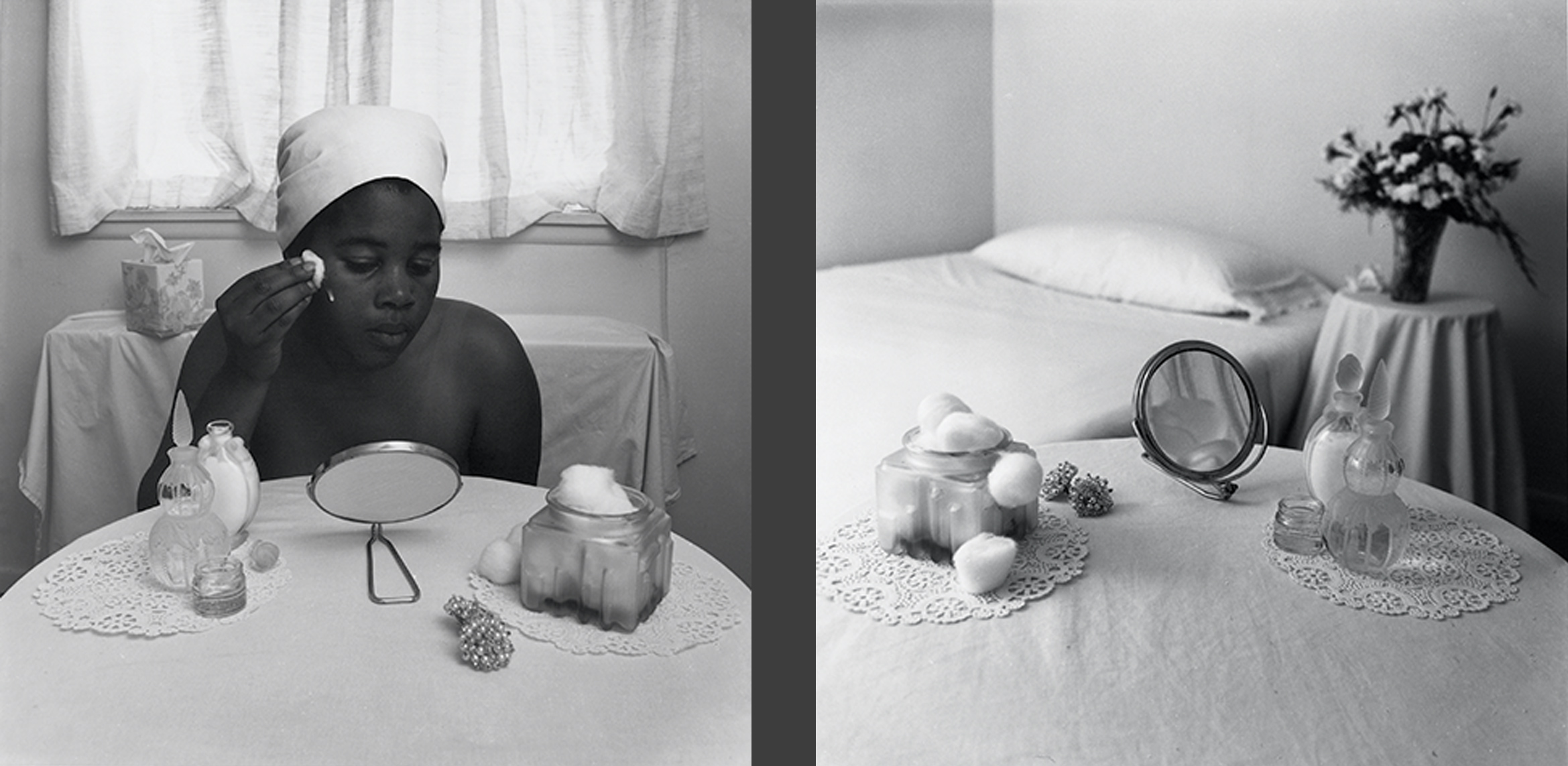
The juxtaposition of self-portraits and still-life photographs in Black Beauty contemplates what it means to exist as a Black woman in contemporary society.
Created in 1991, Walker’s photographs emerged at a moment of profound social and cultural transformation in Britain, as questions of race, identity, representation and belonging became increasingly central.
Black Beauty engages with the shifting and often exclusionary standards of beauty. Through this series, Walker offers visions from a space of her own making: one that values and welcomes her Blackness.
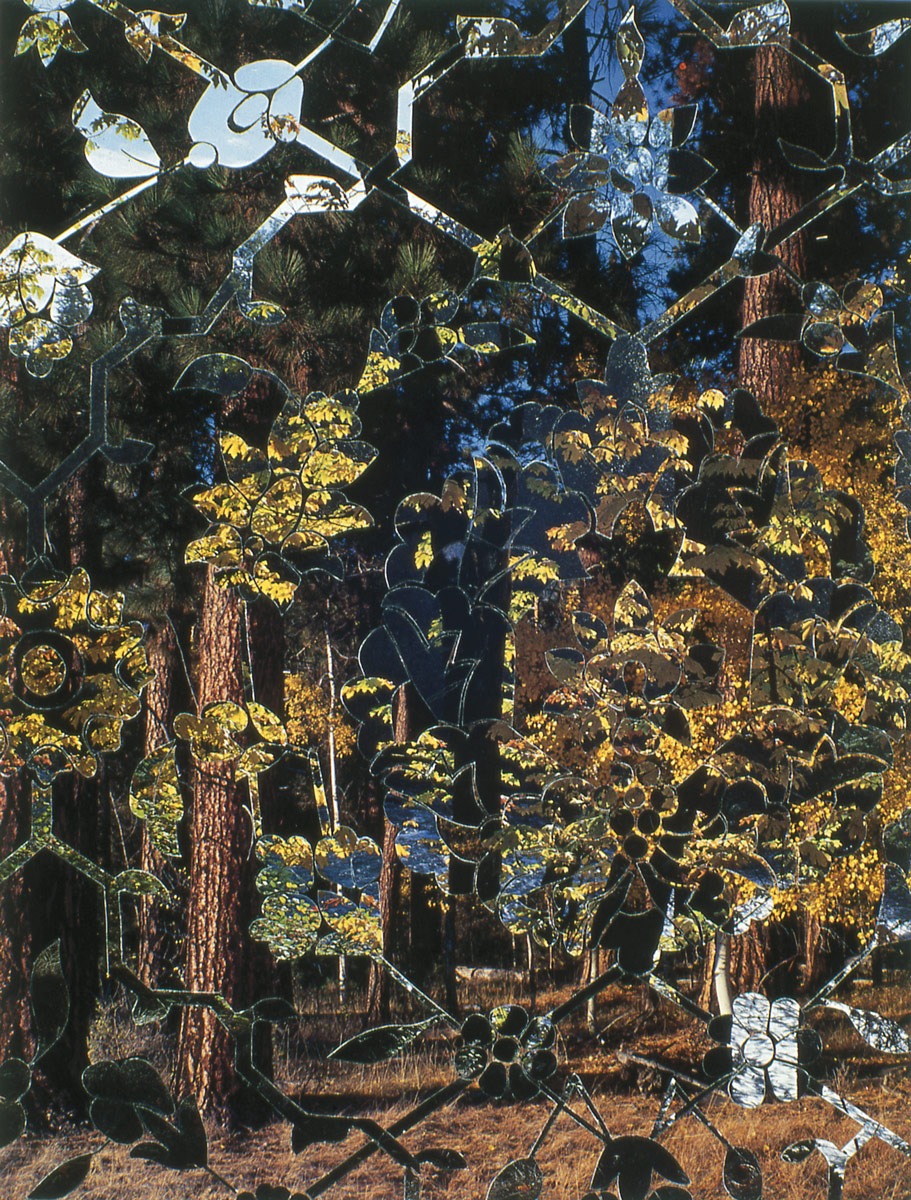
Since the 1990s, Henna Nadeem has created intricately cut and layered photographic collages that interrogate landscape as a contested site of memory and identity.
Disrupting the idea of landscape as a ‘neutral’ space, she assembles fragments of urban and rural imagery drawn from tourist guides, magazines and advertising. Drawing on the visual languages of Islamic art and Japanese geometry, her works reconstruct familiar views into carefully patterned compositions.
In doing so, Nadeem invites us to consider what is visible, what is marginalised and what has been deliberately removed.
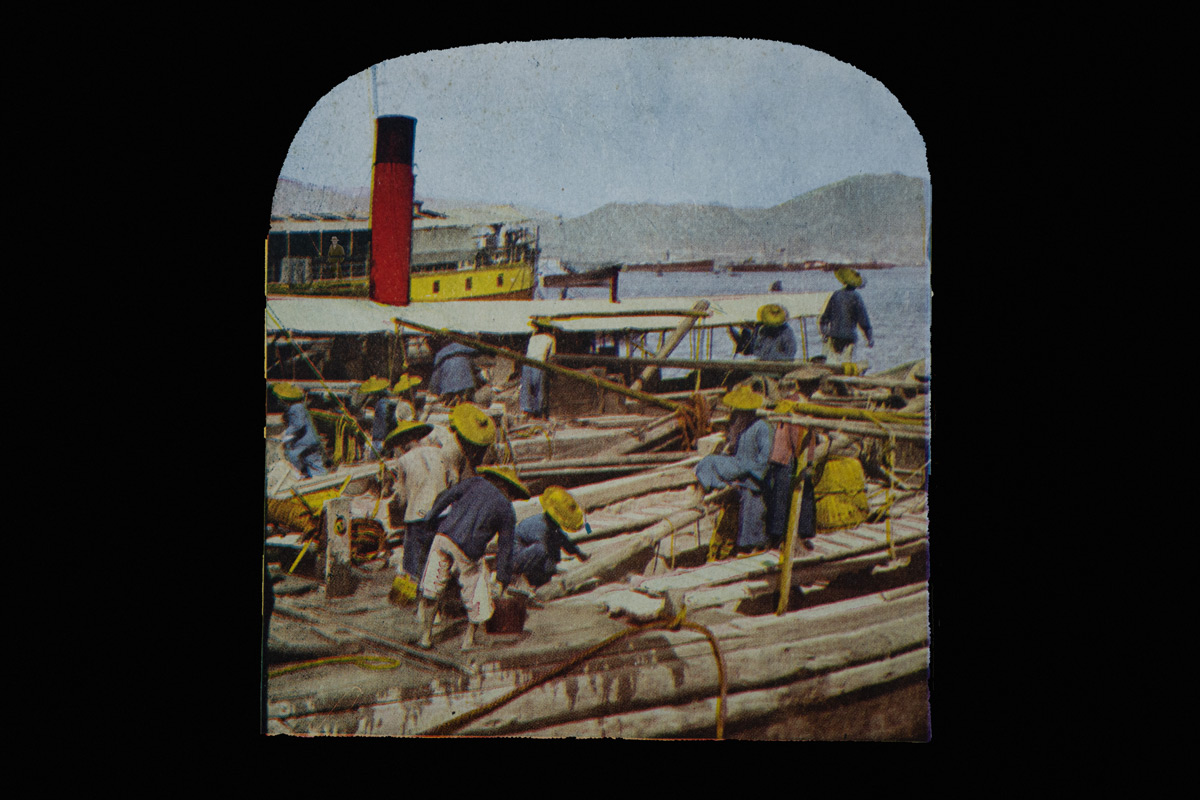
This magic lantern slide is from “The suitcase is a little bit rotten”, a conceptual series of work by Sim Chi Yin using new and found imagery to muse on the potentialities of inheritance and transgenerational memory.
The series makes use of an archive of magic lantern slides from the early 1900s. Chi Yin's interventions enable a re-imaginging of history and photographic time travel, through which the artist creates a fantastical time-space visual repertoire.”
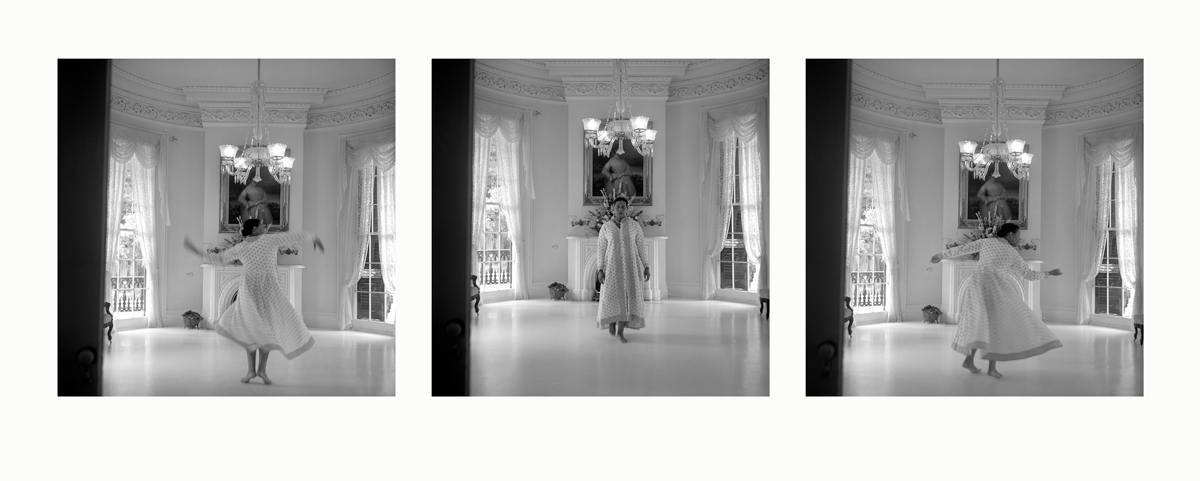
Carrie Mae Weems is an artist known for her exploration of identity, power and history, shaped by her experience as a black woman in America. This work is from The Louisiana Project, in which Weems combines performance and photography to question whose histories are visible and who has the authority to tell them.
In A Single’s Waltz in Time, Weems stages herself dancing through the ‘White Ballroom’ of Nottoway Plantation in Louisiana. Built in 1859 by enslaved labourers, the site stands as a reminder of the wealth and violence that underpin its grandeur.
Through gesture and movement, Weems reclaims the space, unsettling its history and asserting presence within it.
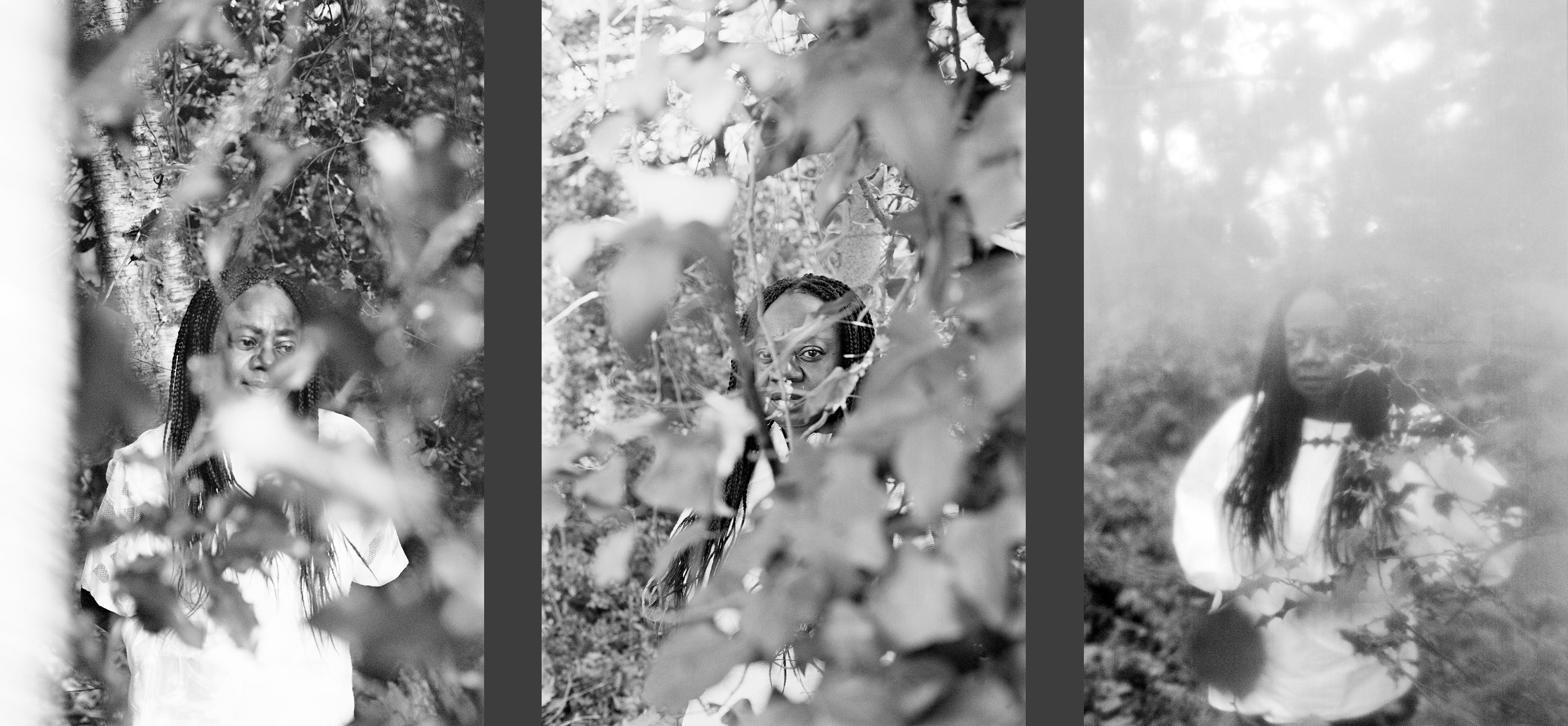
Set within the ancient woodland of Abbey Wood in South London, these works by Dianne Minnicucci explore how vulnerability and discomfort in front of the camera can become acts of self-discovery.
The artist embraces the unease of being photographed – where to look, how to position the body – and allows these moments of uncertainty to shape her self-portraits. The poetic black-and-white images layer light and fragmentation to draw attention to subtle shifts in body language, inviting us to consider what it means to be truly vulnerable.
%20mo%CC%81nica%20de%20miranda%2C%20whistle%20for%20the%20wind%2C%20from%20the%20series%20the%20island%2C%202021.%20supported%20by%20art%20fund.%20commissioned%20by%20autograph%2C%20london.jpg)
Whistle for the Wind traces black presences in Portugal through narratives shaped by migration, resistance and identity. Combining fact and fiction, the work forms part of Mónica de Miranda’s ongoing project The Island, a research-led exploration of Afrodiasporic lives and Europe’s colonial past.
De Miranda uses the island as a metaphor for isolation, refuge and possibility – a space for collective imagining and new forms of freedom. The work invites us to consider our relationship to the past, the lands we inhabit and to imagine more regenerative futures.
%20nhu%20xuan%20hua%2C%20new%20chapter%20%E2%80%93%20archive%20from%20the%20year%20%E2%80%9985%2C%202026.%20commissioned%20by%20autograph%2C%20london.jpg)
Created for Autograph’s current exhibition Nhu Xuan Hua: Of Walking on Fire, this work draws on the artist’s personal archive, reimagining and digitally altering a rare family photograph. Taken in Belgium in 1985, it is the only known image of her grandparents together, captured on the day her parents became engaged.
Rooted in fragmented memory and intergenerational silence, Hua’s work reflects on how personal histories are shaped by absence and gaps in communication. Through reconstruction and distortion, the image becomes a space where the past is continually reinterpreted in the present.
%20Joy%20Gregory%2C%20from%20the%20series%20Autoportrait%2C%201989-90.%20Commissioned%20by%20Autograph%2C%20London.jpg)
In this iconic series of self-portraits, Joy Gregory depicts fragments of her body, face and hands, moving in and out of the frame. Through close engagement with the photographic lens, she explores ideas of beauty, femininity and identity.
Gregory described Autoportrait as “my response to the invisibility, beyond the exotic, of black women in British fashion and beauty images”. Referencing the fantasy and glamour of the catwalk, the work reflects a world from which black women had been largely excluded.
Autoportrait was Autograph’s first artist commission, marking the organisation’s founding in 1988.
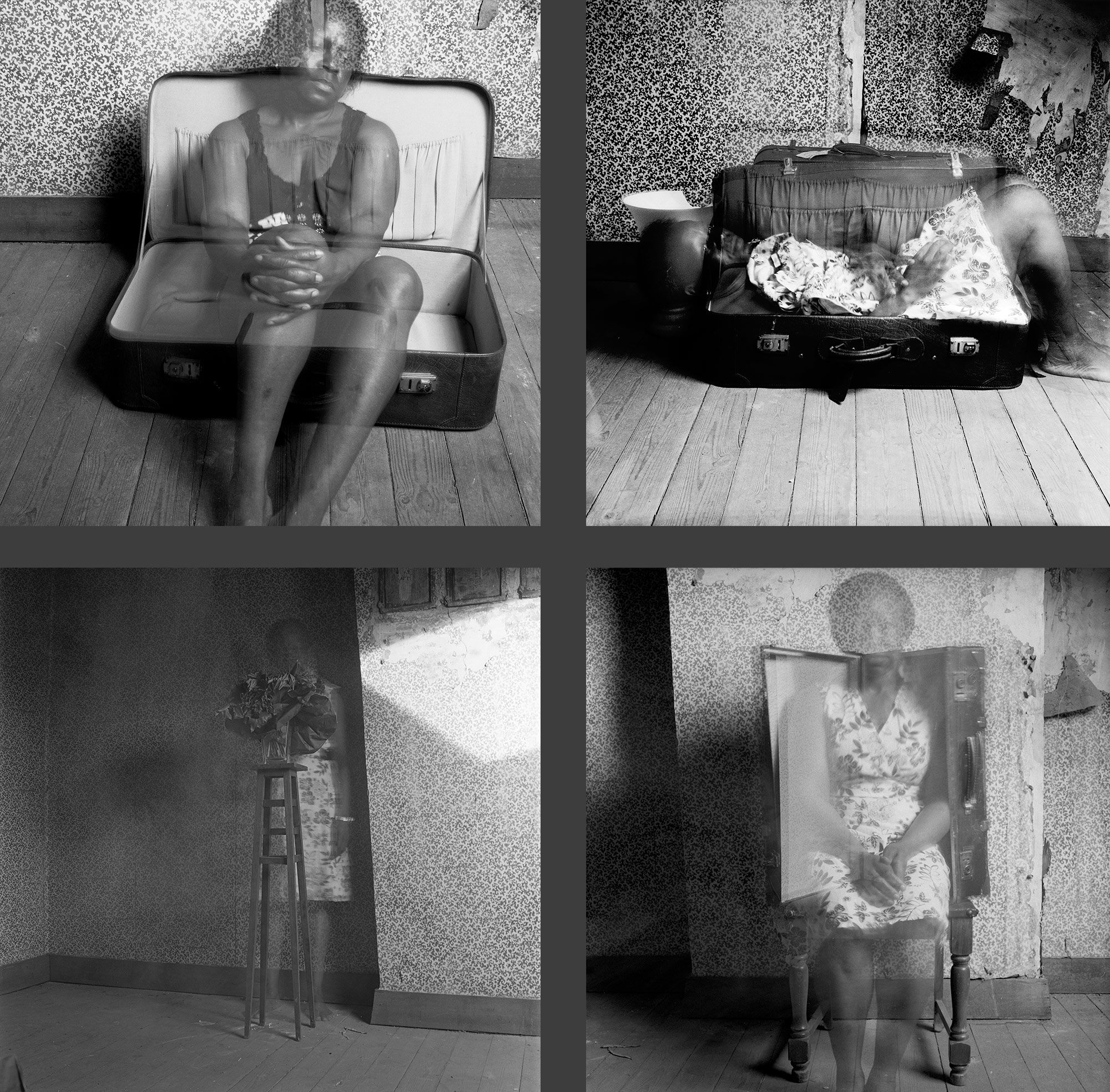
Hélène Amouzou’s self-portraits reflect on displacement, exile and the search for belonging. Created while seeking asylum in Belgium, the works emerge from a prolonged period of statelessness, during which the artist lived in precarious conditions.
Using analogue film and long exposures, Amouzou inscribes her presence into the spaces she inhabits. Her blurred, ghost-like form appears against the worn interior of an attic, evoking absence, waiting and uncertainty. Repeated motifs such as suitcases suggest the instability of life in transit.
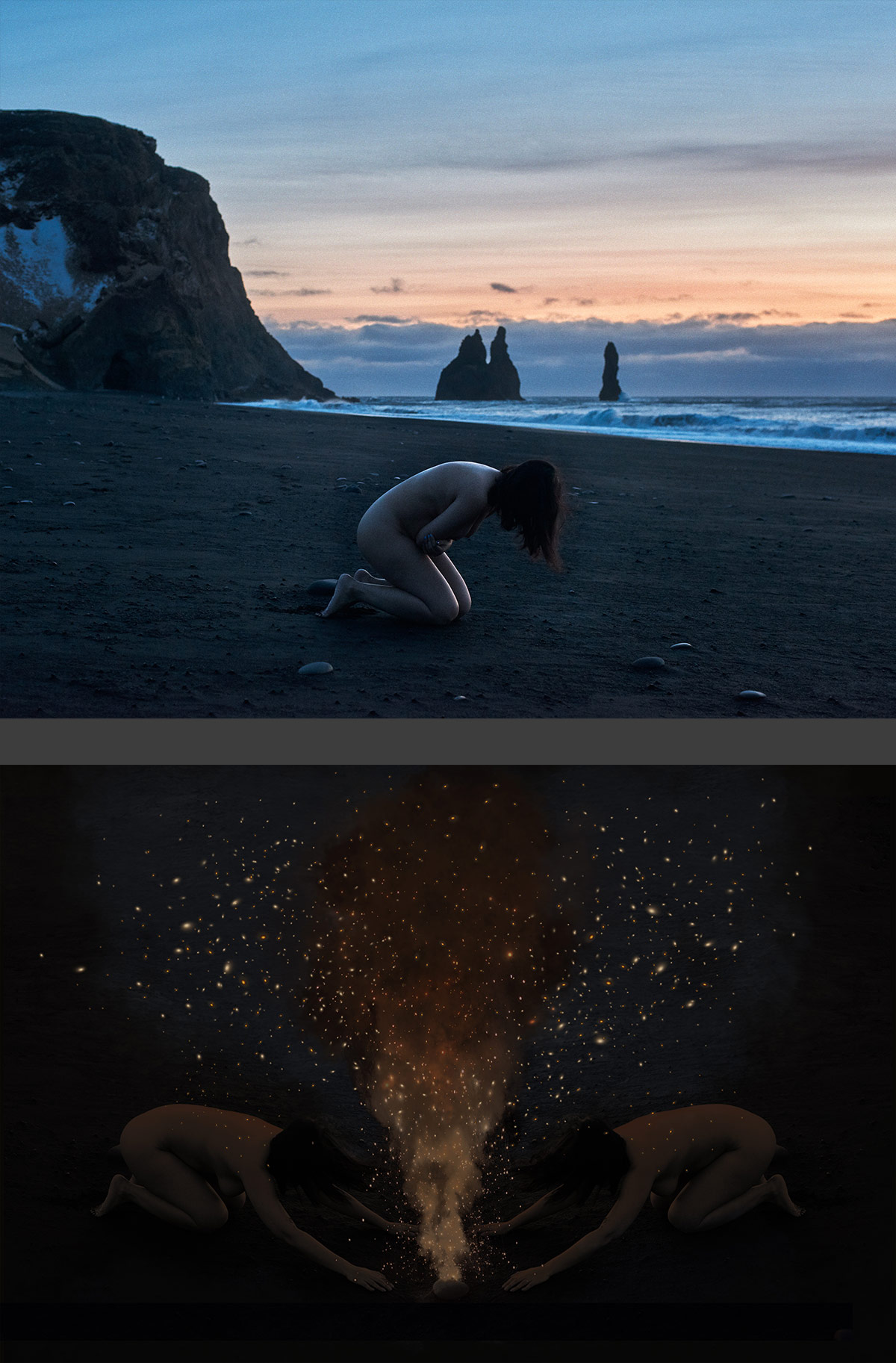
Artist and activist Poulomi Basu reflects on trauma shaped by patriarchal violence through an intimate exploration of her relationship with her mother. Moving between the claustrophobia of home and gestures of resistance, the work traces experiences of survival, care and transformation.
In Basu’s words, “the work is an act of embodied activism – a way of listening to the body, the earth and each other”.’
Working with photography, Basu amplifies women’s voices across the majority world. Drawing on magical realism, ecofeminism and dystopian science fiction, she interweaves the real and the imagined to create images shaped by memory and lived experience.
%20C.%20Rose%20Smith%2C%20Untitled%20no.%2090%2C%20Commissioned%20by%20Autograph%2C%20London%20and%20FotoFest%2C%20Houston.jpg)
Staged at Belmont Mansion in Tennessee, this photograph forms part of C. Rose Smith’s series Talking Back to Power. Her black and white self-portraits centre on a white cotton shirt, photographed at sites connected to the wealth generated through cotton plantations in the American South.
Built through the labour of enslaved people, these grand interiors reflect the histories of violence and exploitation that underpin their opulence.
%20Mo%CC%81nica%20Alca%CC%81zar-Duarte%2C%20Ixchel%20-%20Mayan%20Moon%20and%20Birth%20deity%2C%202021.%20From%20the%20series%20Digital%20Clouds%20Don%E2%80%99t%20Carry%20Rain.%20Courtesy%20the%20artist.jpg)
Set amongst the dying trees of Derbyshire (the home of the industrial revolution), this image is part of the series Digital Clouds Don't Carry Rain (2021 – ongoing), in which artist Mónica Alcázar-Duarte explores issues of climate and ecology, and the connection between indigenous and western botany systems.
The work draws on the concept of 'Nepantla', an ancient term from the Náhuatl language, often cited in Chicano and Latino anthropology. The artist explains: "Nepantla refers to a state of in-betweenness… a spatial concept of ‘being in-the-middle of it’, like in the eye of the storm. And this work emerges from an absence or a recognition of earthlessness in me."
14 – 17 May 2026
Who is seen, remembered and represented in the canon of photography?
Banner image: Poulomi Basu, Fireflies [detail], 2019. Collection of Autograph, London.
All images © the artists: 1) Eileen Perrier, Afro Hair and Beauty, 1998-2003. Collection of Autograph, London. Supported by the Heritage Lottery Fund’s Collecting Cultures Programme. 2) Silvia Rosi, Neither Could Exist Alone, 2020. Commissioned by Autograph, London. 3) Ingrid Pollard, The Valentine Days, 2017. Commissioned by Autograph, London. 4) Lina Iris Viktor, We are the Night – The Keepers of Light, 2015-19. Commissioned by Autograph, London. 5) Zanele Muholi, Bayephi III, Constitution Hill, Johannesburg, 2017. Commissioned by Autograph, London. 5) Sabrina Tirvengadum, Happy birthday to you, 2025. Collection of Autograph, London. 6) Sasha Huber, Khadija Saye - You Are Missed, 2021-22. Commissioned by Autograph, London. Supported by Art Fund. 7) Maxine Walker, from the series Black Beauty, 1991. Collection of Autograph, London. 8) Henna Nadeem, California, 1999-2000. Collection of Autograph, London. 9) Sim Chi Yin, "The suitcase is a little bit rotten", 2022. Collection of Autograph, London. 10) Carrie Mae Weems, A Single's Waltz in Time, 2003/2025. Collection of Autograph, London. 11) Dianne Minnicucci, from the series Belonging and Beyond, 2025. Collection of Autograph, London. 12) Mónica de Miranda, Whistle for the Wind, 2021. Commissioned by Autograph, London. Supported by Art Fund. 13) Nhu Xuan Hua, New Chapter – Archive from the year ’85, 2026. Commissioned by Autograph, London. 14) Joy Gregory, Autoportrait, 1989-90. Commissioned by Autograph, London. 15) Hélène Amouzou, Autoportrait, Molenbeek, 2007-2011. Collection of Autograph, London. Acquired with Art Fund support. 16) Poulomi Basu, Fireflies, 2019. Collection of Autograph, London. 17) C. Rose Smith, Belmont Mansion, 2023. Commissioned by Autograph, London and FotoFest, Houston. Collection of Autograph, London. 18) Mónica Alcázar-Duarte, Digital Clouds Don't Carry Rain, 2021. Collection of Autograph, London.
Join our newsletter and get the latest on Autograph’s exhibitions, events, open calls, digital content, books, prints and fundraising. Find out more.



Autograph is a space to see things differently. Since 1988, we have championed photography that explores issues of race, identity, representation, human rights and social justice, sharing how photographs reflect lived experiences and shape our understanding of ourselves and others.
Support our work

