0
0
0

Writer and critic Chandra Frank explores the capacities of collage to expand conversations around loss, worldbuilding, colonialism and the archive
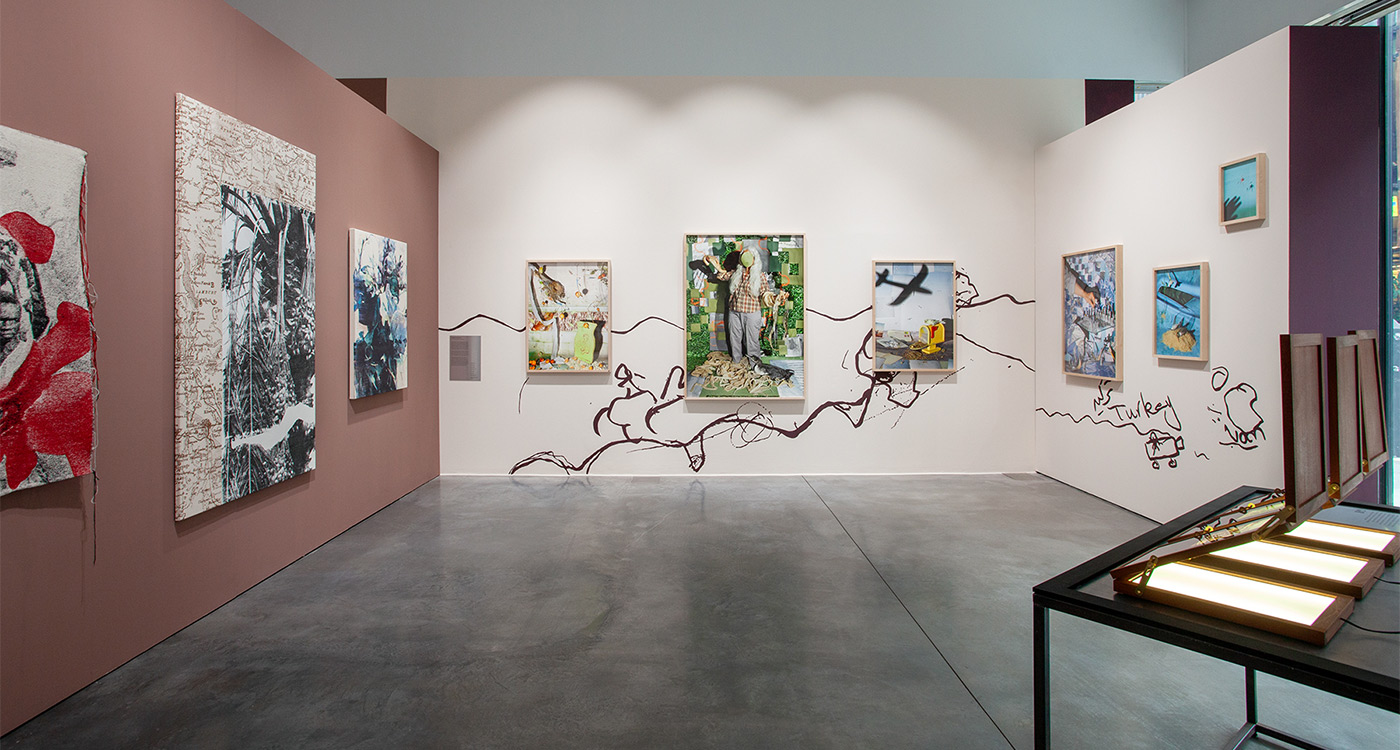
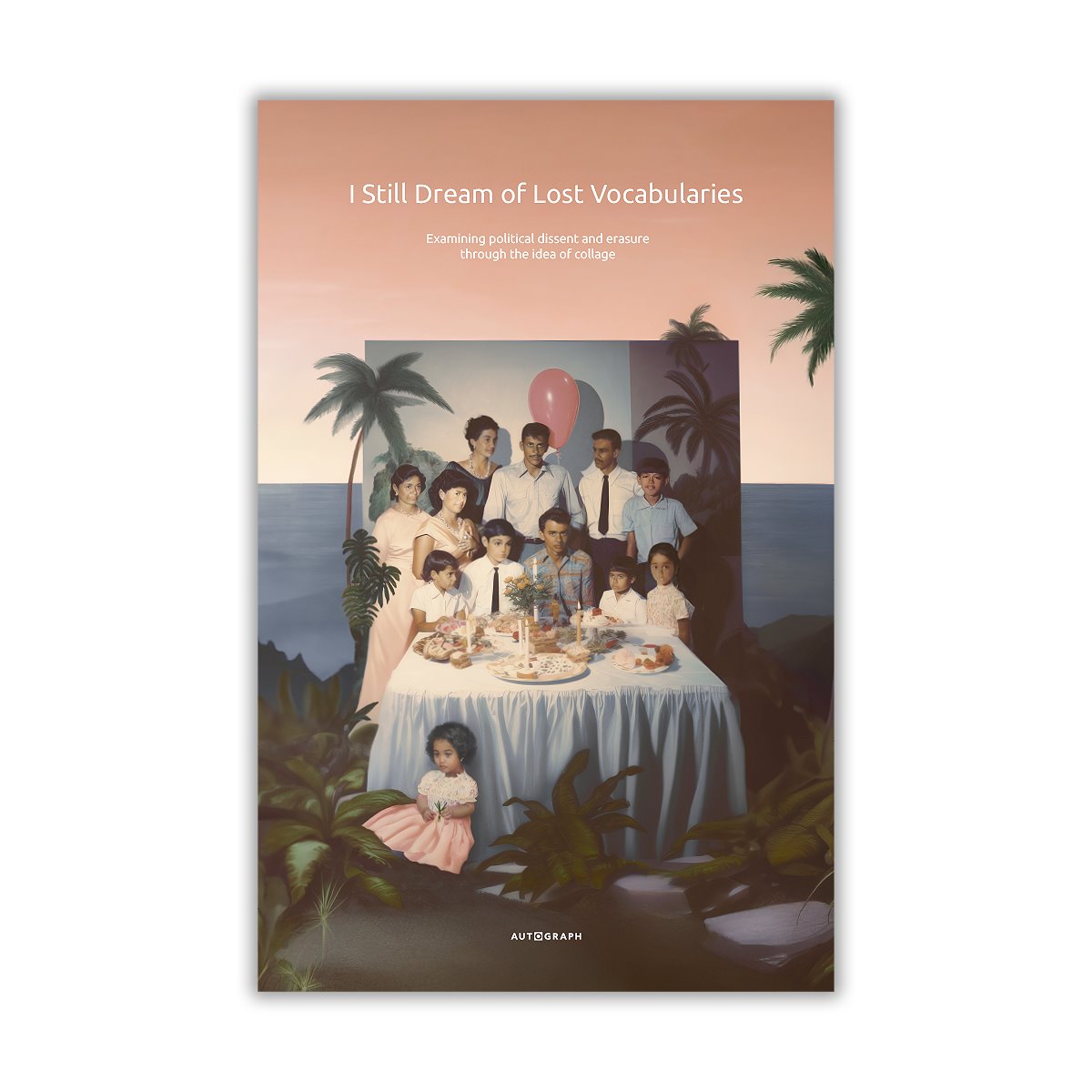
Autograph’s current exhibition, I Still Dream of Lost Vocabularies, brings together the work of thirteen artists working with ideas of collage to examine issues of political dissent and erasure. As part of the exhibition, we commissioned Chandra Frank to write a text considering the qualities of collage and what it offers to conversations around loss, worldbuilding, colonialism and the archive.
This text features in the newspaper published to accompany the exhibition, presenting images of the artists’ work alongside a new text from Autograph’s Senior Curator, Bindi Vora, as well as conversations with artists Arpita Akhanda and Thato Toeba.
I Still Dream of Lost Vocabularies invites us to contemplate how collage reassembles, rethinks and rearranges complex histories. The exhibition traverses “between method and metaphor”, fiction and reality, past and future. Engaging with various collage techniques, the work of the thirteen artists featured in this show rejects neat binaries. In this way, as curator Bindi Vora writes, the exhibition “resists completeness”.
It is within this deliberate resistance that we are able to deepen our engagement with collage. What does collage as a medium tell us about ‘lost vocabularies’? How do the poetics of loss reveal, obscure and trouble static narratives? The different uses of collage in the exhibition bring two interlinked propositions to the fore. First, collage might constitute a ‘lost vocabulary’ in itself. That is, the capacious qualities of collage rearrange singular and narrow readings of loss. Second, as the artists in this exhibition show us, collage is also a mode of worldbuilding. In this sense, collage is often about refusal whilst exploring other aesthetics and mutations. Both these propositions are bound up with contestation, friction and a rejection of linear narratives.
%20arpita%20akhanda%2C%20a%20veil%20of%20memories%20iii%2C%202023.%20courtesy%20the%20artist%20and%20emami%20art%20gallery.jpg)
Arpita Akhanda, A Veil of Memories III, 2023
%20arpita%20akhanda%2C%20a%20veil%20of%20memories%20iv%2C%202023.%20courtesy%20the%20artist%20and%20emami%20art%20gallery.jpg)
Arpita Akhanda, A Veil of Memories IV, 2023
Collage, as evidenced by this exhibition, is exactly powerful because of its ability to shift our vantage point. An edge becomes a beginning. A layer creates another surface or interrupts form. Fragments might anchor us while assembling other kinds of aesthetics. A cut might reveal or liberate. Collage is as much a praxis of unfolding as it is of gathering.
Loss is not necessarily about a demand to be found. For some artists, loss is about trace or the absence thereof. Lost vocabularies might turn into other languages, frames and tongues. In artist Sabrina Tirvengadum’s work, lost family histories of indentured labourers from Mauritius become visualised and reconstructed through generative AI. While Tirvengadum’s works present a kind of digital weaving, artist Arpita Akhanda turns to handwoven paper works. Titled A Veil of Memories, Akhanda’s works engage with the 1947 partition of British India, a cleavage which created India and Pakistan and resulted in a refugee crisis, mass migration and large-scale violence. Through her work, Akhanda interrogates intergenerational memory and considers how inherited family archives warp memory and ideas of belonging.
These different collage techniques refuse generalisations regarding loss and violence. In Akhanda’s work, we see how an attentiveness to place constructs visual language. Collage techniques have the ability to ground us in a temporal and spatial realm without having to abstract a sense of loss. Here, we get to see the different pathways that shape political dissent. It might be worth noting that while collage is often understood as a mode of disruption, its ability to interrupt is just as, if not, more powerful. For example, Kudzanai Violet Hwami’s work grapples with geographic dislocation, Black queerness and spirituality. The surface in Hwami’s painting, titled Expiation, never quite settles. In combining different fragments, Hwami explores the construction of the self in a world filled with digital images. Expiation also shows how the medium of painting folds into collage, again reminding us of how collage provides a different way of seeing.
%20sabrina%20tirvengadum%2C%20family%2C%202023.%20courtesy%20the%20artist%20(1).jpg)
Sabrina Tirvengadum, Family, 2023
%20sabrina%20tirvengadum%2C%20happy%20birthday%20to%20you%2C%202025.%20courtesy%20the%20artist.jpg)
Sabrina Tirvengadum, Happy birthday to you, 2025
Indeed, the vocabularies of loss often conjure up possibility as worldbuilding. Photomontage techniques have allowed for ‘cutting’ and rearranging hierarchies. I am interested in what collage tells us about process. That is, if we refuse completeness then we must also attune to the mess or muck of the matter. In my own curatorial work and research, I have been thinking with concepts such as spillage and leakage. In tracing what ‘spills’ or ‘leaks’, we become attentive to the limitations of existing structures and forms. As a creative researcher, collage helps shapes these inquiries for me.
If we situate collage outside of its dominant associations and histories, we see other entanglements at work. Often, these entanglements refuse to be neatly contained. I must briefly note that it is exciting to see this translated into an exhibition space. Beyond medium, the selection and arrangement of the works allow for unexpected connections to emerge. In a diasporic and geographically rich engagement with collage, we see how different histories, narratives and imaginings rub up against each other. These frictions are productive. Put differently, often conversations pertaining to migration become violently flattened. Yet together the works in this exhibition ruminate on the interlinked histories, for instance, between indentured labour, colonialism and slavery.
%20sunil%20gupta%2C%20from%20the%20series%20trespass%2C%201992-1995.%20collection%20of%20autograph%2C%20london.jpg)
Sunil Gupta, from the series Trespass, 1992 - 1995
In terms of other imaginings and unexpected connections, we might also think about the notion of alignment. That is, how diasporic and/or queer aesthetic practices often trouble assumed or normative alignments. Collage as a medium is known to tear down hierarchies or binary ways of thinking.¹ We might situate these processes as loud disruptions, but collage is also often sensuous. If anything, the exhibition reminds us that collage is interwoven with the everyday.
This connects with Kobena Mercer’s imperative analysis of Black British art practices, considering collage and diasporic aesthetics. Mercer situates collage as an aesthetic strategy, which allows for a deeper understanding of plurality in the everyday and mundane.² Put differently, collage is about the poetics of movement. Indeed, as the exhibition shows, the medium itself has ‘moved’ as it were. Sunil Gupta’s series Trespass consists of digital collages created in the 1990s with one of the very first Apple computers, demonstrating how ‘movement’ became part of an assembly technique. The series provides an important insight into how collage practices shaped cultural production from a queer diasporic perspective. The title Trespass of course also conjures up experiences of the in-between and the liminal.
What photomontage and collage demand of us is a different engagement with witnessing. The shifting use of photographs is not solely about changes in technological advancement and the politics of representation. If anything, the scope of artists included in the exhibition require that we think critically about surveillance and spectatorship as well as the landscapes that become produced by regimes of power. Intervening then also becomes a necessary mode of worldbuilding. Unsettling the static moves beyond ‘response’ but rather becomes an interplay between framing and recreating. Witnessing and dreaming of lost vocabularies then requires us to become curious about the work that fragments do. A fragment becomes a reference or gesture. It pulls us closer into the entanglement of form. Perhaps the collage techniques used in the exhibition remind us to listen and sense for other tongues, languages and vocabularies precisely because formation is a praxis of experimentation.
_______
¹ For more on queer/feminist studies, diaspora and aesthetics, see the following works: Unruly Visions: The Aesthetic Practices of Queer Diaspora by Gayatri Gopinath and In Visible Archives: Queer and Feminist Visual Culture in the 1980s by Margaret Galvan.
² Kobena Mercer, keynote address for the Now & Then…Here & There: Black Artists & Modernism Conference, 6 October 2016, Chelsea College of Arts, London. Event produced by Black Artists & Modernism (BAM) in association with Iniva (Institute of International Visual Arts).
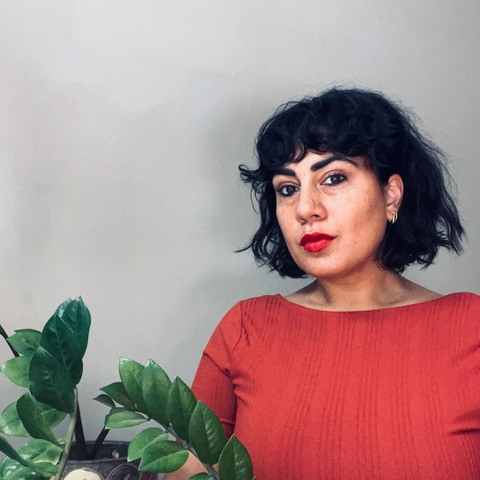
Chandra Frank is assistant professor of women’s, gender and sexuality studies at the University of Cincinnati and an independent curator. She is the 2024-2027 Taft Professor of the Public Humanities.
Her interdisciplinary research focuses on feminist and queer of color movement work, possibilities of dissent, the politics of water and the ways in which race and the environment work as terrains of power. She is a founding member of the Tidal Studies Group, a collaborative collective exploring the rhythms, currents, spillage and intimacies of water. Over the last decade, she has been active as an independent curator and worked with various international institutions such as the Bonnefanten Museum, Cincinnati Contemporary Art Center, 198 Contemporary Arts & Learning, Framer Framed and District Six Museum.
Banner image: Installation photograph by Kate Elliott.
Images on page: 1-2) Arpita Akhanda, A Veil of Memories III-IV, 2023. © and courtesy the artist and Emami Art Gallery. 3) Sabrina Tirvengadum, Family, 2023. © and courtesy the
artist and Autograph, London. 4) Sabrina Tirvengadum, Happy birthday to you, 2025. © and courtesy the
artist and Autograph, London. 5) Sunil Gupta, from the series Trespass, 1992-1995. © the artist. Collection of Autograph, London. Commissioned by Focal Point Gallery/Essex County Council.
About the author: Image courtesy of Chandra Frank.
Join our newsletter and get the latest on Autograph’s exhibitions, events, open calls, digital content, books, prints and fundraising. Find out more.



Autograph is a space to see things differently. Since 1988, we have championed photography that explores issues of race, identity, representation, human rights and social justice, sharing how photographs reflect lived experiences and shape our understanding of ourselves and others.
Support our work